Orkes Conductor vs. Camunda (BPMN)
The Shift from Legacy BPMN to Modern Workflow Orchestration
The evolution of workflow orchestration has led organizations to migrate from traditional BPMN-based solutions like Camunda to modern, scalable, and highly reliable orchestration engines such as Orkes Conductor. Camunda, built on legacy BPMN standards, presents limitations in flexibility, scalability, and integration with modern microservices and event-driven architectures. Orkes Conductor, derived from Netflix Conductor, offers a cloud-native, microservices-driven, and highly scalable orchestration engine. This document provides a detailed comparison of the two platforms.
Comparative Analysis
Orkes Conductor vs. Camunda (BPMN)
 Orkes Conductor
  Camunda (BPMN)
 Deployment Models
User Access Control
Cloud Support
Security & SSO
High Availability
Workflow Definitions
Visual Workflow Builder
Versioning
Workflow Definition Decoupling
Built-in System Tasks
Integrations
Human Tasks
Massive Parallelism
Error Handling & Compensation
Scalability
AI Orchestration
Long-Running Workflows
Workflow Monitoring
Execution Visualization
Task-Level Debugging
Error Identification
Audit Trails
AI Agents
LLM Integration
Predictive Orchestration
Automated Decision Making
Conversational AI Workflows
Migration from BPMN to Conductor
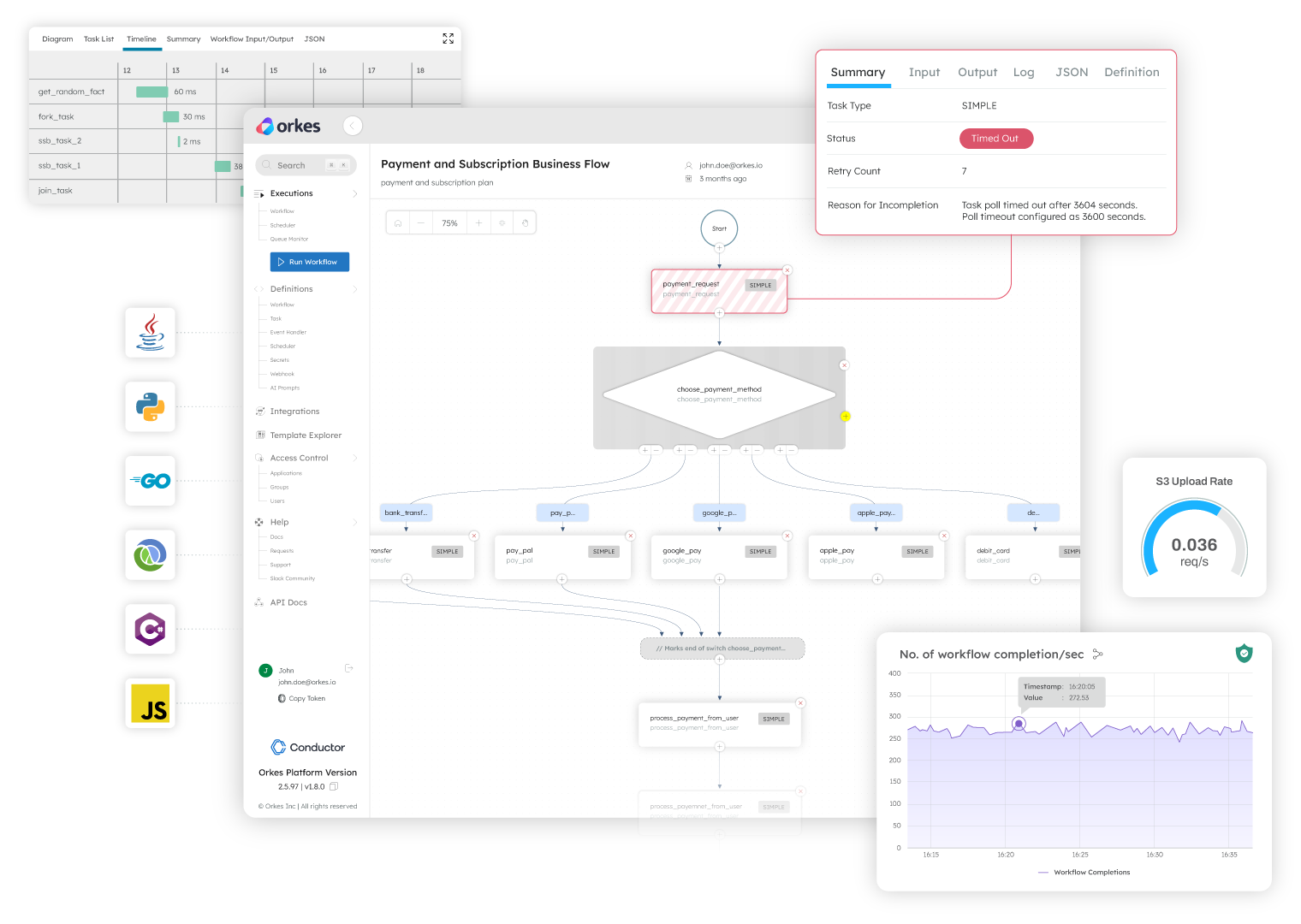
Migrating from BPMN-based solutions like Camunda to Orkes Conductor provides organizations with a seamless transition to a modern, microservices-native orchestration system. Orkes provides automated migration tooling that can convert BPMN workflows to Conductor-compatible JSON workflows, ensuring a smooth and efficient migration process with minimal downtime.
Key Migration Benefits
Automated Workflow Conversion
Convert existing BPMN workflows into Conductor's JSON-based DSL with minimal manual intervention.
Zero Downtime Deployment
Migrate workflows incrementally, running both systems in parallel before full switchover.
Seamless Integration with Existing Services
Easily integrate Conductor workflows with APIs, microservices, and third-party cloud tools.
Eliminate Legacy Bottlenecks
Move away from tightly coupled BPMN architectures to a scalable and flexible microservices-first model.
Performance & Cost Optimization
Reduce infrastructure overhead with Conductor's cloud-native orchestration and event-driven execution model.
Migration from BPMN to Conductor
Assessment and Planning
Identify existing BPMN workflows, dependencies, and critical processes.
Automated Conversion
Use Orkes' migration tools to translate BPMN processes into Conductor's DSL.
Parallel Execution & Validation
Run migrated workflows alongside existing BPMN processes to validate performance and accuracy.
Full Deployment & Optimization
Transition fully to Conductor, optimize performance, and scale as needed.
Decommission Legacy BPMN
Retire outdated workflows and leverage Conductor's advanced orchestration capabilities.
Companies that transition to Conductor benefit from higher scalability, improved reliability, and better integration with modern cloud and microservices architectures.
Camunda and other BPMN-based solutions are legacy approaches that struggle to scale in modern cloud-native, microservices-driven environments. Orkes Conductor, with its event-driven, scalable, and highly flexible architecture, is the clear choice for organizations looking to modernize their workflows.
For enterprises looking to migrate from BPMN to Conductor, Orkes provides comprehensive support and automated tools, ensuring a smooth and efficient transition.