Process Modeling with Orkes Conductor
Orkes Conductor is a modern process modeling tool that helps enterprises design, run, and optimize complex business processes that span services, AI agents, and humans. It removes the bottlenecks of traditional BPM suites and gives teams a single place to model, automate, and observe real production workflows.
What I love most about Orkes is how it adapts to us. It's so flexible that we don't have to change the way we do business to fit the technology. Our use cases range from managing human tasks, to generating contracts, to handling financial transactions—and even with our complex, niche institutional rules, Orkes just works. Other major software vendors force us to either compromise our business rules or build custom scripts to patch things together, adding cost, risk, and technical debt. With Orkes, it's simple to make workflows match how we operate.


Talk to an expert












The Challenges with Today's BPMN and Process Modeling Tools

Rigid BPMN diagrams that do not scale
Traditional BPMN based process modeling tools often produce rigid diagrams that are difficult to change once deployed. Updating a process means redrawing large parts of the model, coordinating risky releases, and accepting long change cycles. This slows innovation and makes teams hesitant to experiment.

Poor developer experience
Most process modeling tools are built around drawing diagrams, not building resilient systems. Developers are pushed to the edges, working with limited APIs, brittle connectors, and weak debugging tools. The gap between a model and production behavior is filled with custom scripts and one-off integrations that are hard to maintain.

Lack of true observability and adaptability
When a workflow fails, it is often hard to see what went wrong or where time was spent. Many process modeling tools provide minimal insight into live state, failed dependencies, or performance across distributed systems. Without deep observability, teams cannot easily improve SLAs, reduce bottlenecks, or adapt to new business requirements.
“What I love most about Orkes is how it adapts to us. It's so flexible that we don't have to change the way we do business to fit the technology. Our use cases range from managing human tasks, to generating contracts, to handling financial transactions—and even with our complex, niche institutional rules, Orkes just works. Other major software vendors force us to either compromise our business rules or build custom scripts to patch things together, adding cost, risk, and technical debt. With Orkes, it's simple to make workflows match how we operate.”
Why Choose Orkes Conductor as Your Process Modeling Tool
Pain point: Rigid BPMN diagrams that do not scale
Orkes advantage: Orkes Conductor turns static models into flexible, versioned workflows that can evolve quickly while keeping production safe.
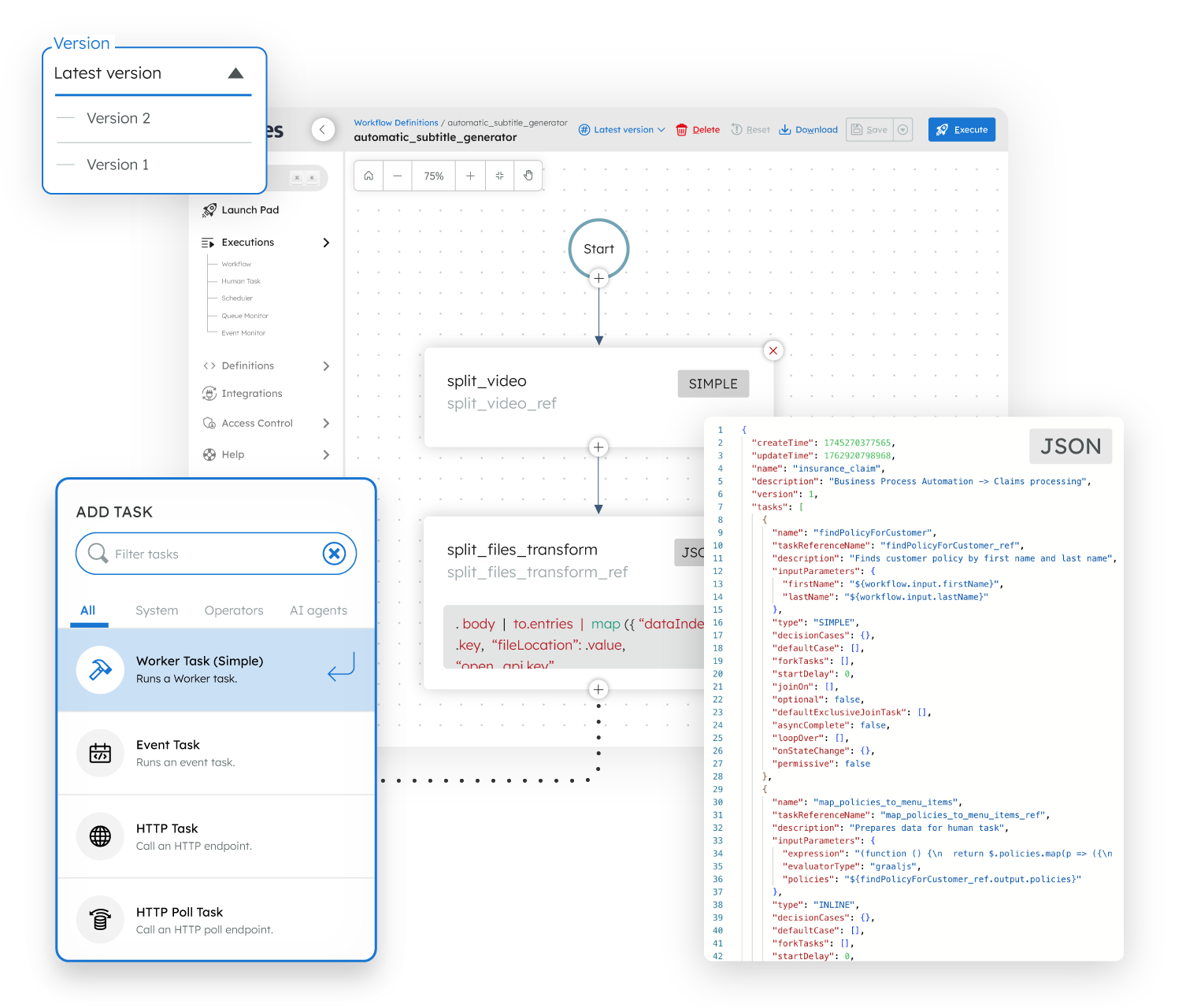
- Visual and JSON-based modeling lets you update workflows without redrawing complex diagrams.
- Versioned workflows support safe rollouts and instant rollbacks, so experimentation does not put critical operations at risk.
- Dynamic task routing allows you to plug in new services, rules, and agents without rearchitecting the entire process.
With Orkes, your process modeling tool becomes a living system of record for how work actually runs in the organization.
Pain point: Poor developer experience in non-BPMN platforms
Orkes advantage: Orkes Conductor gives developers first-class orchestration capabilities and a smooth path from design to running code.
- Rich APIs and SDKs connect workflows directly to microservices, queues, and data stores.
- Built-in debugging, tracing, and test environments help teams troubleshoot at both the workflow and task level.
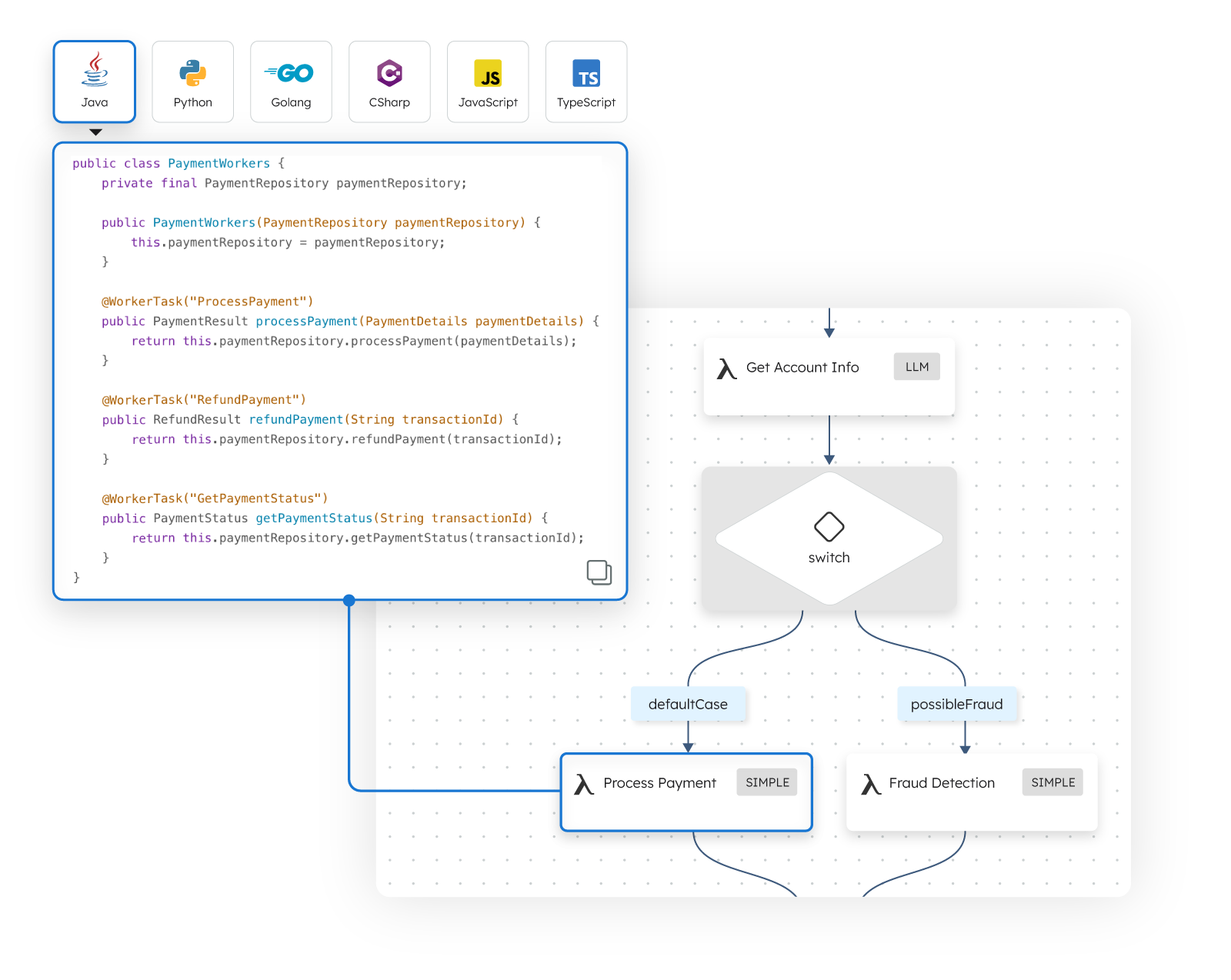
- Polyglot workers let teams write business logic in any language while Conductor takes care of orchestration, retries, and reliability.
Instead of diagrams in one tool and code in another, Orkes brings modeling and execution together in a single process modeling platform.
Pain point: Lack of true observability and adaptability
Orkes advantage: Orkes Conductor provides deep observability across all workflows so you can see, measure, and improve every process.
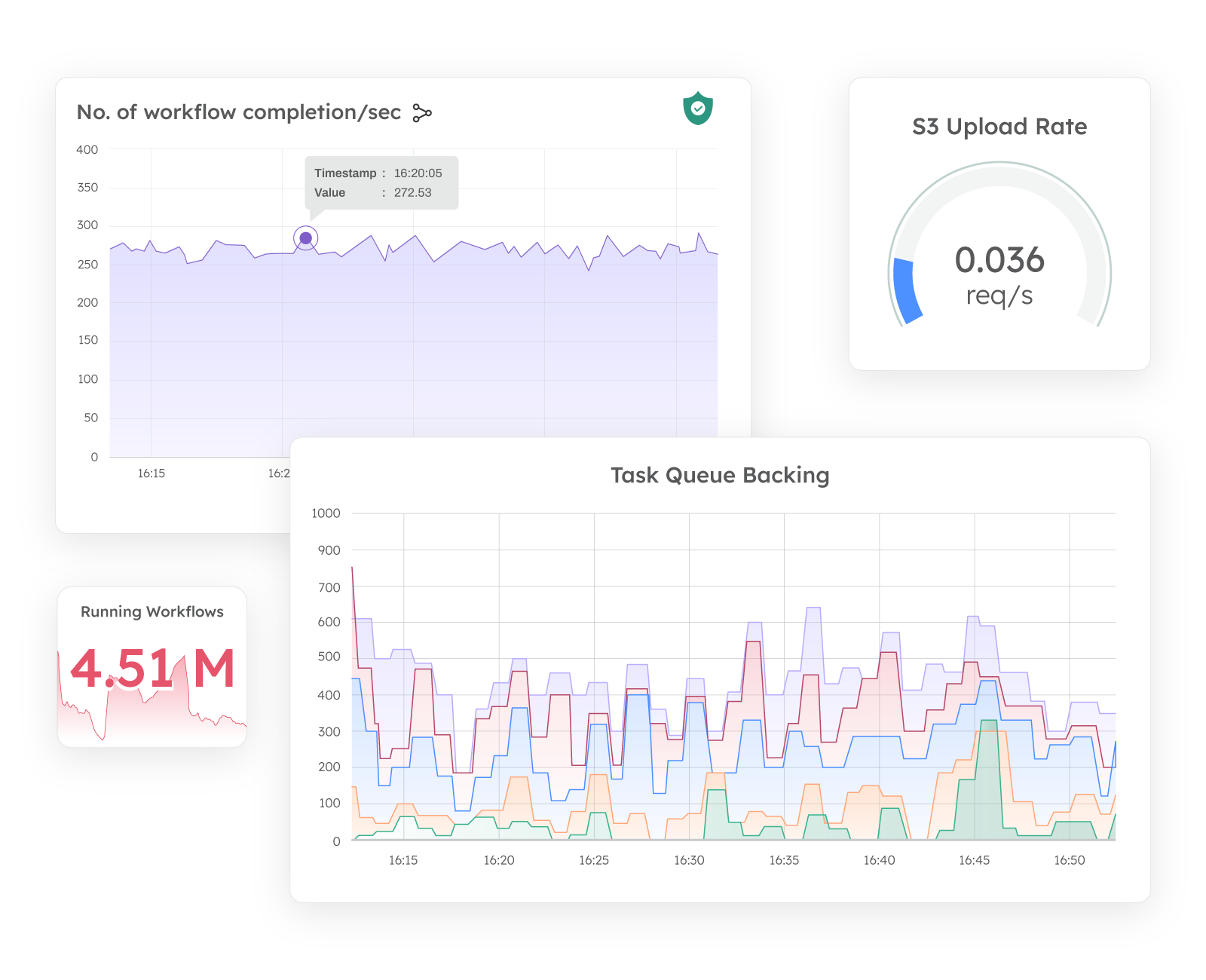
- Real-time dashboards show the live state of each workflow and task across systems and regions.
- Logs, metrics, and traces pinpoint failed dependencies, slow steps, and workflows that are stuck in excessive retry loops.
- Analytics on execution history reveal trends that help you improve SLAs, plan capacity, and refine business rules.
Your process modeling tool becomes a continuous improvement engine instead of a static design artifact.
Key Features of Orkes Conductor as a Process Modeling Tool
Visual Builder
Design and edit workflows with a built-in visual editor that stays in sync with JSON definitions and underlying services. Business users can shape process flows, while developers connect services and implement tasks, all within one shared model.
Durable Execution
Run long-lived workflows that survive failures, restarts, and timeouts without custom state management. Orkes manages retries, backoff, and compensation so your modeled processes behave predictably in real production conditions.
Event-Driven Orchestration
Model event-driven processes that react to messages, notifications, and system events. Use built-in integrations with message queues and event handlers so workflows respond in real time to changes across your environment.
Versioning and Progressive Delivery
Create multiple versions of a workflow and roll them out safely. Use canary or A/B models to test changes on a subset of traffic, then promote or roll back instantly based on performance and outcomes.
RBAC and Governance
Apply granular role-based access control to workflows, tasks, secrets, and AI prompts. Orkes provides audit-ready permissions so teams can share a process modeling tool across departments while maintaining strong governance and compliance.
Agentic Workflows with AI and LLMs
Model AI agents and LLM-powered steps as first-class tasks within your workflows. Orchestrate how AI interacts with tools, humans, policies, and core systems, instead of treating AI as a hidden side call buried in application code. Orkes enables truly agentic process models that combine AI decision-making with business rules and human oversight.
Next Steps
We'll get back to you within 1 business hour

Schedule a demo
Pick a convenient time to see our solution in action and we'll walk you through the core features and how it fits your needs.

Get a Tailored Demo
We'll customize the demo around your use case and priorities, so you see exactly how we solve your specific challenges.

Align on a Plan
Together we'll map out a tailored implementation roadmap and success criteria to ensure seamless adoption.
FAQs
What is a process modeling tool?
A process modeling tool helps organizations visualize and define how work moves through systems, teams, and decisions. It makes it easier to understand, automate, and optimize business operations. Orkes Conductor goes further by turning those models into executable workflows with built-in reliability and observability.
How is Orkes different from other process modeling tools?
Most process modeling tools emphasize diagramming and require a separate implementation phase in code. Orkes Conductor combines modeling, execution, and monitoring in one platform. Your models connect directly to microservices, APIs, human tasks, and AI agents, so they are production ready from the moment you design them.
Can Orkes integrate with our existing systems?
Yes. Orkes integrates with REST APIs, message queues, databases, cloud platforms, and AI systems. You can also build custom workers in any language to connect proprietary or legacy systems. All of these become reusable building blocks inside your process models.
Does Orkes support BPMN?
Yes. Orkes can import and execute BPMN 2.0 workflows and then extend them with dynamic logic, event driven triggers, and AI driven decision steps. This lets you enhance existing BPMN investments while moving to a more flexible process modeling tool.
Is Orkes suitable for enterprise-scale automation?
Yes. Orkes powers billions of workflow executions with enterprise grade reliability, high availability, and horizontal scalability. Features such as versioning, RBAC, audit trails, and multi region deployment make it suitable for global enterprises and regulated industries.
Can I track and optimize process performance?
Orkes provides real time dashboards, metrics, logs, and traces that show how each process behaves in production, so you can spot bottlenecks, track SLAs, and test changes across workflow versions. Orkes also exposes rich metrics to your existing observability stack, letting you export data to Prometheus and visualize it in Grafana, or send detailed execution metrics and logs to Datadog for centralized monitoring, alerting, and correlation with the rest of your infrastructure.
How does Orkes handle security and compliance?
Orkes includes encryption in transit and at rest, granular RBAC, detailed audit logging, and integration with identity providers. These capabilities help you enforce internal security policies and meet external regulatory requirements while using a shared process modeling tool.
Can business users and developers collaborate in Orkes?
Yes. Business users can design and adjust workflows visually, while developers connect services and implement workers through APIs and SDKs. Both groups work on the same underlying models, keeping process design and system behavior aligned.
Does Orkes support human-in-the-loop workflows?
Yes. You can model approvals, reviews, escalations, and manual interventions as explicit steps in the workflow. Tasks can be assigned to users or groups, paused while waiting for decisions, and resumed automatically once input is provided.
How do we begin using Orkes Conductor as our process modeling tool?
A great starting point is the developer playground, where your team can experiment with workflow definitions, connect sample workers, and run test executions in a safe environment without touching production systems. Once developers are comfortable modeling and running processes in the playground, you can pick a single high impact process such as order processing, onboarding, or a critical back office flow, connect it to real systems, run a limited pilot, and then gradually expand coverage as teams adopt Orkes as the central process modeling and orchestration platform across your organization.

Ready to Build Something Amazing?
Join thousands of developers building the future with Orkes.