Telecom Automation Solutions with Orkes Conductor
Orkes Conductor is telecom automation solution that enables providers to automate service provisioning, billing, and network operations through orchestrated workflows that combine microservices, humans, and agentic AI. It delivers the agility, reliability, and intelligence needed to modernize telecom operations and improve customer experience.
“Orkes has been instrumental in increasing developer agility, creating cost efficiencies, and building highly reliable and secure applications. We’re so impressed with the results that we are migrating more workflows from other platforms to Orkes and initiating all flows on Orkes.”


Talk to an expert












The challenges with today's telecom operations

Complex system integrations
Telecom workflows span network operations systems, billing platforms, customer management systems, and network management tools that rarely share a single orchestration layer.

Manual provisioning and fault resolution
Human driven service provisioning and incident handling slows down service delivery, increases costs, and erodes customer satisfaction. Many steps live in static documents, tickets, and email instead of being executed as automated workflows.

Poor SLA tracking and visibility
Traditional logistics automation tools cannot respond quickly to route disruptions, inventory shortages, or demand spikes. Updating logic often requires code changes in multiple systems.

Unstructured AI and automation pilots
AI initiatives for ticket triage or anomaly detection often run separately from core workflows. Insights are hard to operationalize, so they rarely turn into consistent, automated actions that improve day to day operations.
“Orkes has been instrumental in increasing developer agility, creating cost efficiencies, and building highly reliable and secure applications. We’re so impressed with the results that we are migrating more workflows from other platforms to Orkes and initiating all flows on Orkes.”
Why choose Orkes Conductor for Telecom automation
Pain point: Complex system integrations
Orkes advantage: Orkes Conductor acts as the telecom orchestration layer so a single workflow definition spans network operations tools, billing systems, customer platforms, and network elements.
- Model service activation, billing, and customer journeys as end to end Conductor workflows instead of isolated jobs.
- Connect systems using Conductor tasks and workers over APIs and message queues instead of brittle point to point integrations.
- Reuse shared workflow templates and tasks across products, regions, and teams so new offers can launch quickly using the same standardized orchestration patterns.
Pain point: Manual provisioning and fault resolution
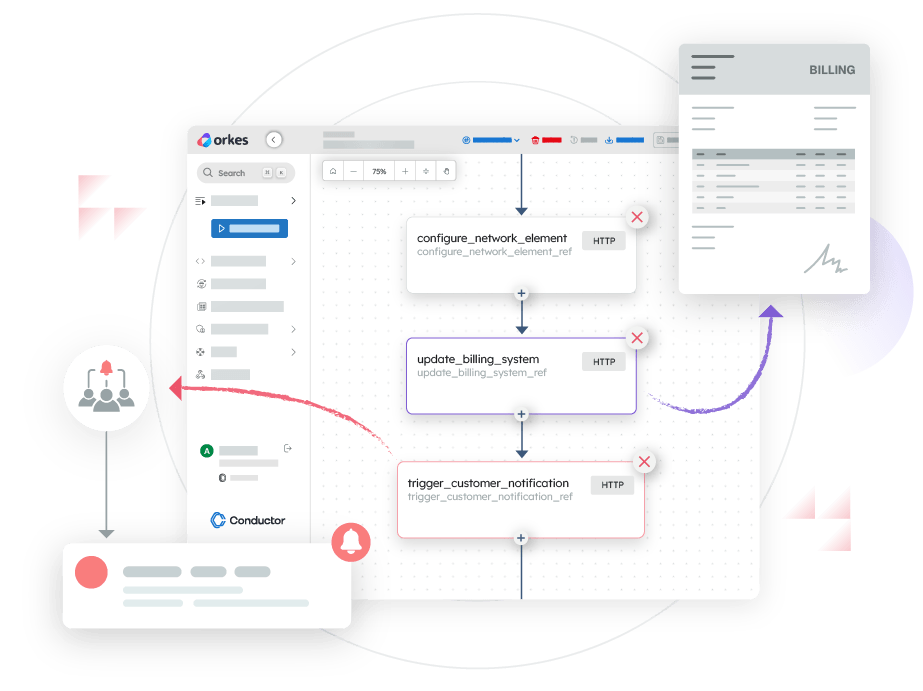
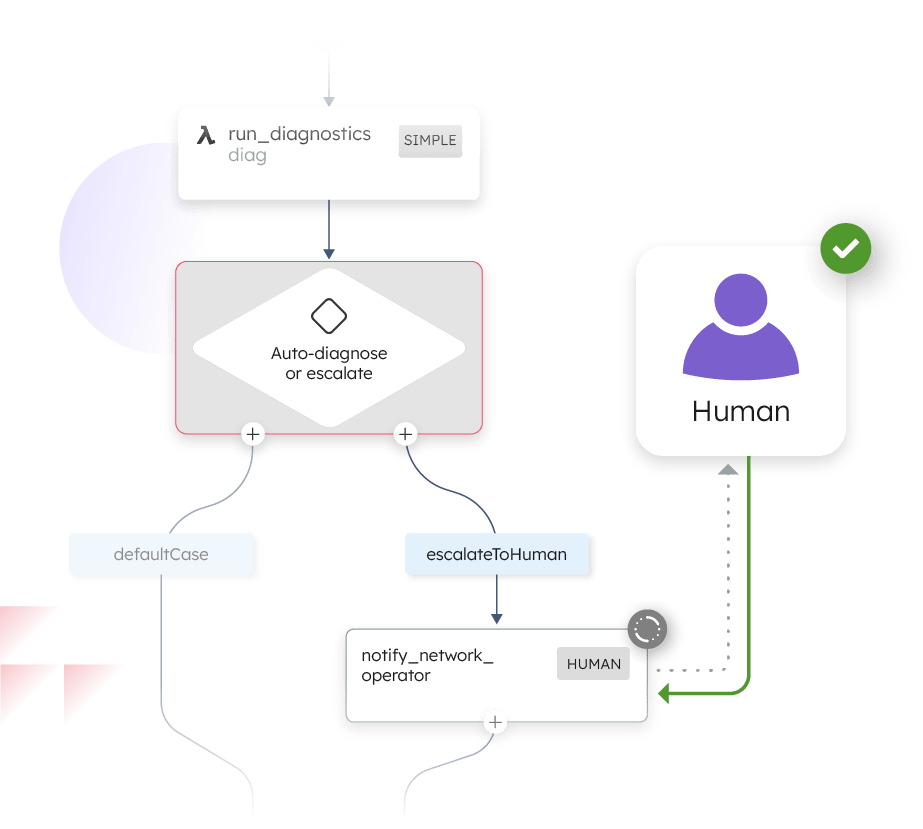
Orkes advantage: Orkes Conductor automates provisioning and fault management as reusable workflows, with human tasks where operator judgment is required.
- Use workflow tasks and workers to automate service activation, configuration, and rollback across network elements.
- Trigger standardized diagnostics and remediation workflows automatically when alarms, tickets, or events are received.
- Route complex or high risk cases to human tasks in the workflow so operators see full context and resolve issues faster and more consistently.
Pain point: Poor SLA tracking and visibility
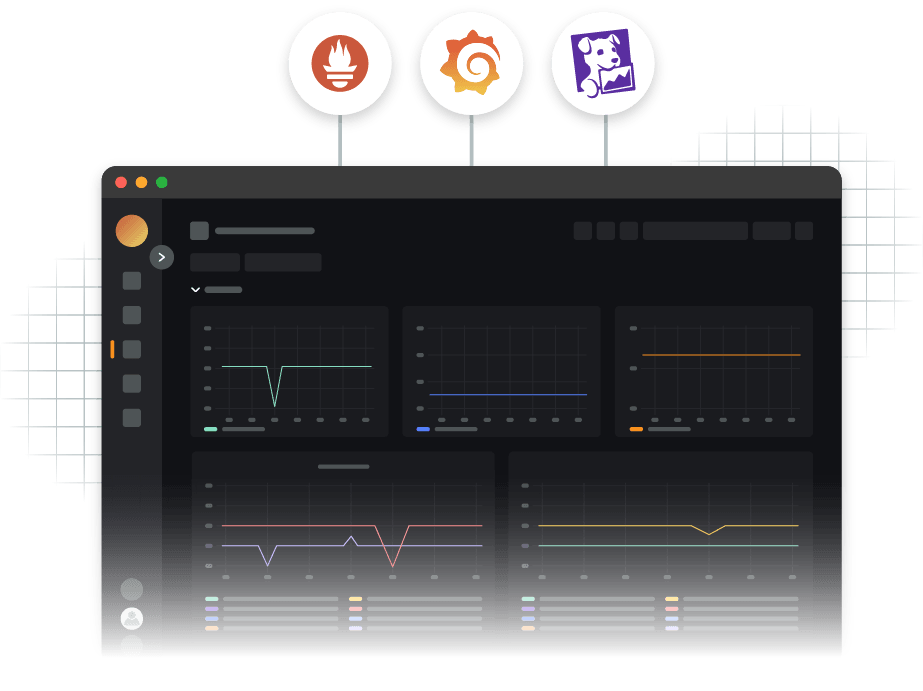
Orkes advantage: Orkes Conductor turns every telecom process into a tracked workflow execution, with real time dashboards, traces, and metrics mapped directly to SLAs and connected to your observability stack.
- Track workflow status, incident timelines, and SLA metrics in Conductor dashboards and export telemetry to tools such as Prometheus, Grafana, or Datadog.
- Use execution traces and logs to pinpoint exactly where processes slow down, fail, or bounce between teams instead of stitching together partial views.
- Correlate workflow level metrics with network and application data in your central monitoring platform so operations teams share a single view of health and SLA risk.
Pain point: Unstructured AI and automation pilots
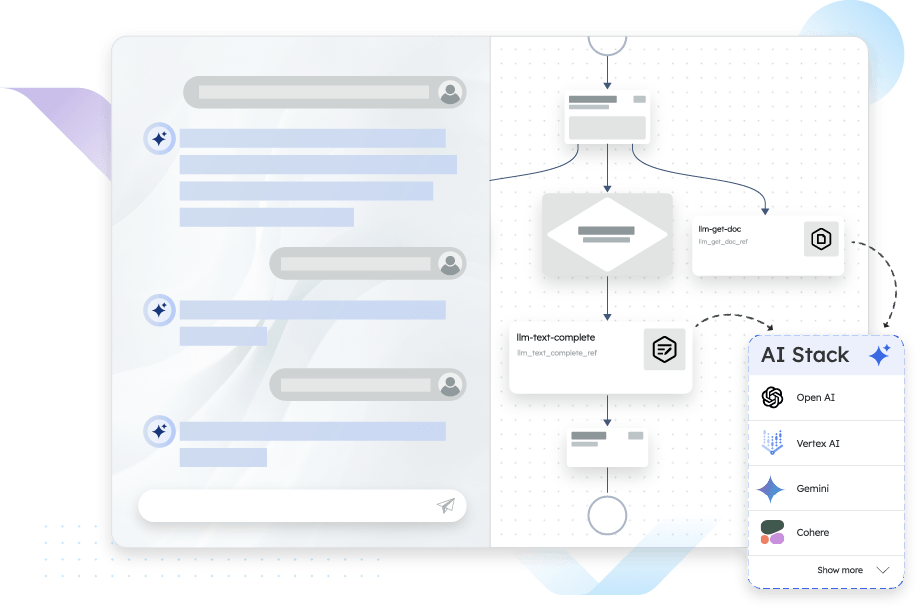
Orkes advantage: Orkes Conductor embeds agentic AI as first class workflow tasks so AI insights are executed under the same policies, observability, and control as the rest of your telecom automation solution.
- Integrate AI agents for ticket triage, predictive maintenance, and anomaly detection as dedicated tasks inside telecom workflows.
- Pass structured context into AI tasks and constrain actions such as rerouting traffic or opening tickets through workflow level policies.
- Monitor AI effectiveness by tracing every AI call and outcome in workflow executions, then refine models and behavior using workflow versioning and controlled A/B style rollouts.
Key features of Orkes telecom automation solution
Visual orchestration for telecom provisioning and billing
Model provisioning, activation, change management, and billing workflows visually while keeping JSON definitions in sync so operations and engineering share the same process logic.
Integration with network operations, billing, and customer platforms
Connect existing telecom systems such as network operations tools, billing systems, and customer management platforms using APIs, queues, and custom workers so workflows can span ordering, assurance, billing, and care without manual coordination.
Agentic AI driven fault detection and resolution
Use AI agents to detect anomalies, categorize tickets, prioritize incidents, and trigger automated runbooks that reduce mean time to resolution and improve uptime.
Network configuration automation
Automate configuration changes, rollouts, and rollbacks across network devices with durable workflows that handle retries, approvals, and compliance checks.
Real time SLA monitoring and analytics
Track SLA performance, incident lifecycles, and customer impact in real time with dashboards, metrics, and traces that map directly to workflows and services.
Secure, auditable governance controls
Apply RBAC, policy controls, and audit logging across provisioning, billing, and support workflows so you meet internal policies and external regulatory requirements.
Next Steps
We'll get back to you within 1 business hour

Schedule a demo
Pick a convenient time to see our solution in action and we'll walk you through the core features and how it fits your needs.

Get a Tailored Demo
We'll customize the demo around your use case and priorities, so you see exactly how we solve your specific challenges.

Align on a Plan
Together we'll map out a tailored implementation roadmap and success criteria to ensure seamless adoption.
FAQs
Which telecom operations can Orkes automate?
Orkes automates provisioning, activation, billing, ticketing, and customer care workflows by connecting network operations systems, billing platforms, customer systems, and network management tools within one orchestration platform.
How does Orkes integrate with existing telecom systems?
Orkes uses APIs and message queues to connect with existing systems. Custom workers extend automation to legacy or proprietary platforms while keeping orchestration centralized and observable.
How do agentic AI capabilities enhance telecom automation solutions?
AI agents monitor network conditions, classify and prioritize tickets, detect anomalies, and trigger corrective actions or recommendations, improving uptime and reducing mean time to resolution.
Can Orkes support human approvals and interventions?
Yes. Human approvals, reviews, and interventions can be modeled as workflow tasks so operators stay in control where needed while automation handles repetitive work.
How does Orkes help with SLA tracking?
Orkes provides real time dashboards, traces, and metrics across processes, making it easier to monitor SLA adherence, identify recurring issues, and prioritize improvement efforts.
Is Orkes scalable for global telecom networks?
Yes. Orkes executes millions of workflows concurrently across regions and data centers with fault tolerance, high availability, and horizontal scalability.
Can developers customize telecom workflows in Orkes?
Developers can use SDKs and APIs to build custom workers and integrations while operations teams manage and adjust workflows through the visual builder.
How secure is Orkes for telecom operations?
Orkes offers enterprise security features such as encryption, RBAC, SSO, and detailed audit logs, supporting compliance with internal policies and external regulations.
Does Orkes support agentic telecom workflows natively?
Yes. AI agents can be first class tasks for triage, recommendation, and remediation, operating under the same observability and control as other workflow steps.
How do we get started with telecom automation solutions on Orkes?
A common starting point is to automate a single process such as service activation or incident triage in the Visual Builder. You can explore this quickly in the Orkes developer playground, where you can sign up and get started for free, then expand to more services and regions as you prove value.

Ready to Build Something Amazing?
Join thousands of developers building the future with Orkes.