- AGENTIC
- ENGINEERING
Orkes Conductor Embeddings Explained: The Tasks Behind Semantic Search & AI Workflows
 Maria Shimkovska Content Engineer
 Here’s a quick and easy rundown of how to use Orkes Conductor’s LLM embedding tasks to turn your text into vectors, store them in a database, and use them for things like semantic search, recommendations, and smarter routing in your workflows.
If you’ve read recent articles on vector embeddings and vector databases you may be curious about what tasks we have available for you to work with embeddings in your workflows. This article goes exactly over those.
But first, a quick refresher: what are embeddings, really?
Embeddings turn text into numerical vectors (for example, the word "password" might become something like [2.3, 0.5, 1.3,...]) that capture meaning. That let’s your workflows do smarter things, like:
- help users find the right document even if they search with the “wrong” words,
- detect similar support tickets or bug reports,
- match customers to the right product or piece of content,
- identify anomalies or suspicious behavior based on past patterns.
Embeddings are also used in both semantic search and semantic routing. Both rely on semantic meaning (the intent or idea behind words, what someone truly means rather than the exact words they say).
- Semantic search is the process of finding the most relevant results based on meaning. For example, a user might search for “reset login credentials”, and semantic search can surface documents titled “How to change your password”, because the meaning is similar, even though none of the words match.
- Semantic routing uses embeddings to automatically decide where a workflow, message, or user request should go based on its meaning. Like directing a support ticket to the correct team (billing, technical, refunds) even if the user doesn’t use those words.
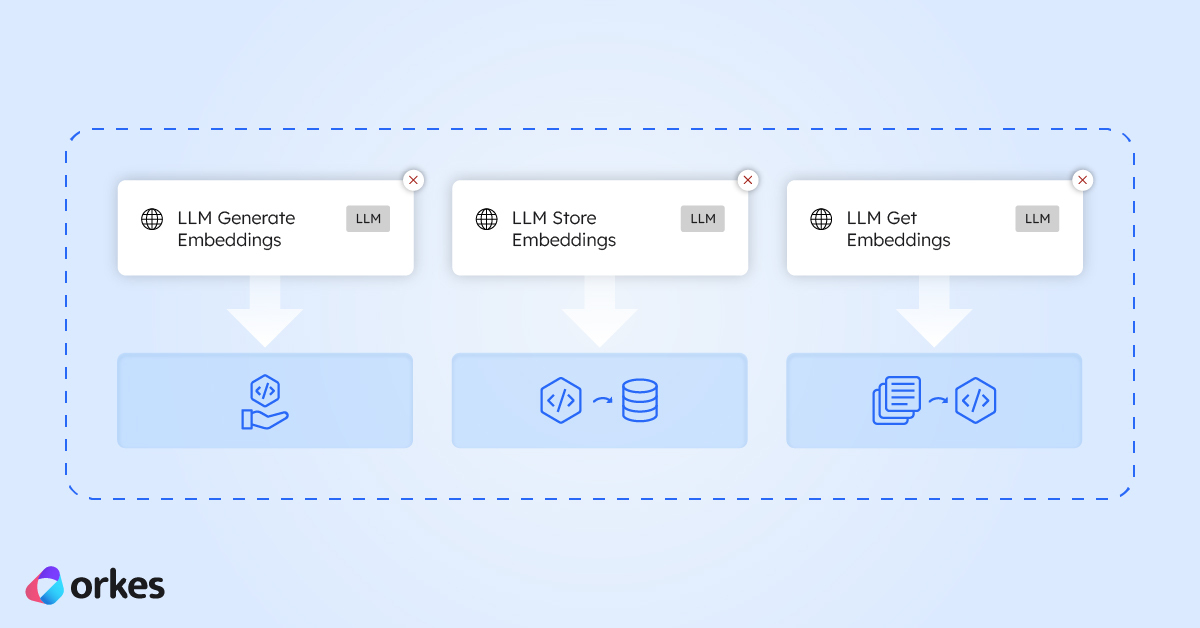
Here are the three Orkes Conductor tasks that make it easy to work with embeddings in your workflows.
LLM Generate Embeddings
This task take any text you give it (like user queries, product descriptions, support tickets, logs, or documents) and converts it into an embedding to represent its meaning in numbers.
For example, if you have a workflow with a user input “I want to change my password”, the task generates an embedding for that sentence and returns it in the result field, like this:
{ "result": [ 0.015542618, -0.042827383, 0.005124084, 0.017521484, -0.0012842973, -0.0012122194, 0.022370363,... // Ellipses here because the vector is a long list 0.017246278, 0.038476497, -0.025659736, 0.01224014, 0.027992439, 0.0032615254, 0.003109179 ]}The above list of numbers represents the vector’s dimensions. Each number is one dimension of the embedding.
Like this you can store the embedding in a vector database of your choice as part of your workflow.
LLM Store Embeddings
Once you’ve generated your embeddings, this task lets you save them to a vector database so you can actually use them.
Store the embeddings in a vector database (Conductor has integrations with Pinecone, Weaviate, Postres, and MongoDB) so your workflows can efficiently index and search through large volumes of text or data.
Feel free to look more into how to integrate each one in the docs as well. Each database has its own little quirks, but the docs walk you through exactly how to set up whichever one you choose.
LLM Get Embeddings
Retrieve the closest or most relevant embeddings for tasks like semantic search (e.g., “find me similar errors”), recommendations (“customers who wrote this review also liked…”), or intelligent routing.
The difference between LLM Get Embeddings and LLM Search Index
While going through the docs you may have noticed that there is a task called LLM Search Index, which is used to search a vector database as well.
The difference between the two tasks is:
- LLM Get Embeddings searches with an existing embedding. You use this task when you already have an embedding (e.g., from LLM Generate Embeddings) and you want to avoid regenerating it or you want to run multiple lookups against the same vector.
- LLM Search Index searches with raw text. It generates an embedding for that raw text using a model you specify and then searches the vector database using that embedding.
| Task | You provide | What it does | Best for |
|---|---|---|---|
| LLM Search Index | Natural-language text query | Generates a new embedding and searches the vector DB | Semantic search from plain text |
| LLM Get Embeddings | An existing embedding vector | Searches the vector DB using that exact embedding | Reusing embeddings or performing repeated lookups |
Conclusion
Embeddings open the door to smarter workflows from semantic search to recommendations to intelligent routing (also referred to as semantic routing). With Conductor’s built-in tasks for generating, storing, and retrieving embeddings, you can add these capabilities pretty quickly.
If you’re ready to experiment, extend an existing workflow, or build something new, Conductor gives you a straightforward way to work with embeddings at any scale. Try it out and see how quickly you can turn ideas into real, production-ready AI features.