AGENTIC
Why You Can’t Scale Agentic Workflows Without Orchestration and How Conductor Delivers

Maria Shimkovska
Content Engineer
Last updated: July 22, 2025
July 22, 2025
5 min read


Join thousands of developers building the future with Orkes.
People don’t like being micromanaged. AI agents don’t mind. In fact, if you want reliable results, you should micromanage them. At least with the current generation of AI agents.
AI agents are exciting. They take on the work that used to drag on for us, completing it quicker and with a pretty high degree of accuracy, thanks to their autonomy and reasoning capabilities. But their independence comes with risks.
Once you connect them to real data and users, agents can behave unpredictably, taking unintended actions and violating vital policies. That's horrifying for any business. How can you trust a system taking previously human actions, if it doesn't have a human brain to understand consequences?
This unpredictability also makes consistent, safe outcomes hard to guarantee to users. Without clear rules and boundaries, agents can skip checks, misuse data, or make decisions that ripple across your system. As you add more agents, in order to scale, manual oversight becomes harder, and the risk of a single bad decision grows.
And these challenges appear long before production scale. What we need is to make agentic systems predictable, auditable, and controlled, even as they grow more complex. To allow us to gain all these exciting benefits of AI agents without all the negative consequences like unpredictability and the loss of user trust.
These are exactly the challenges Haven King (our Cloud Architect and Developer) tackled in his AI Camp Seattle talk earlier this year. He shared practical strategies for scaling and managing complex agentic workflows without sacrificing safety or control.
I also really enjoyed this talk, How to Build Scalable AI Agent Workflows with Orkes Conductor, by Viren (our Founder & CTO). Stick around till the end, because the audience Q&A has some great questions you might be wondering about too.
But if long videos aren’t your thing, or you just want the key takeaways before watching, this blog is for you.
I've seen some confusion about the two terms online. It's all relatively new so confusion is totally normal. But let's clear it up.
AI Agents = autonomous (or semi-autonomous) programs that "think" and act toward a goal. You can make an argument about whether the current state of AI Agents is truly autonomous, but that is a conversation for a different article. Regardless, think of AI agents like telling your system, “Here is the goal. Figure it out and just do it however you think is best.”
Agentic Workflows = organized step-by-step processes that not only embed AI agents where autonomy makes sense but also add essential components like clear rules, human checkpoints, and full visibility, so the work stays on track and under control. This is like saying to your process, “Here’s the overall plan. Follow these steps, and make decisions along the way, but stay within this structure.”
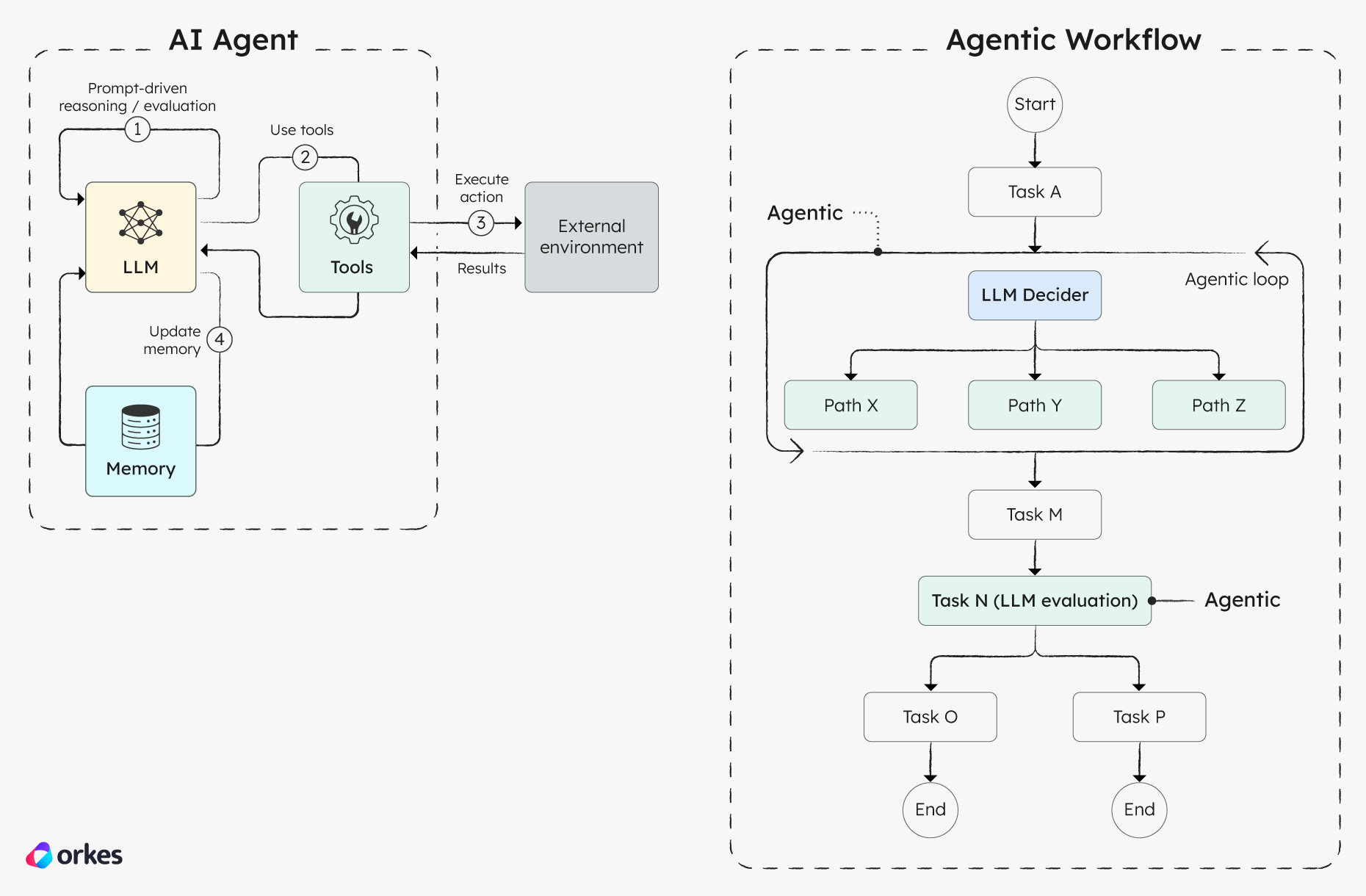
Agentic workflows give you tighter control over outcomes, making the overall system far more deterministic and predictable than a lone agent. Because the same inputs are funneled through the same rails every time, you can trust the process to yield the same result, a must in production, where surprises aren’t always welcome.
I like to think of the workflow itself as the weave that ties everything together: API calls, database queries, data transformations, human approvals.
An orchestrator like Conductor then becomes the glue, where you can build those workflows. What I personally love about working with Conductor is the visual aspect of it. It's really easy to get started with it. And even if you’re still fuzzy about concepts like AI Agents and agentic workflows, once you start implementing them things become much clearer. Concepts start to suddenly click.
We have a deeper breakdown between the two: Agentic AI Explained: Workflows vs Agents.
Quick answer: Because beyond a lone AI agent, only orchestration can impose the guardrails that keep multiple agents aligned and deliver deterministic, repeatable outcomes every time.
Orchestration has become an integral part of building agents. Gone are the not-so-distant times when people were fine with a single AI agent that just checks your calendar and lets you know if your 2 p.m. overlaps with the dentist appointment you booked three weeks ago. As we are pushing the boundaries of what these agents can be built to do, the need of orchestrating them has become non-negotiable.
No surprise there, though. Coordination has always been the backbone of software. Even in non-agentic codebases, we rely on orchestrators: think Kubernetes scheduling pods, Airflow directing data pipelines, or a traditional message queue fanning tasks out to microservices. Those systems prove the point: once you have more than one moving part, you need something (or someone) in charge of the dance.
I think of them like a team of people working together. It's not the most original comparison, but it works. Without a playbook and a project manager, even the most talented individuals end up duplicating work, waiting on each other, or pulling in opposite directions. The same is true for agentic workflows: as you add more agents, the chaos grows—unless you have a way to coordinate them.
Orchestration provides the structure and rules that keep everyone aligned. Assigning the right task to the right agent, ensuring nothing falls through the cracks, and adapting as conditions change. Just like a well-run team needs a plan and a leader, scalable agentic systems need orchestration to perform at their best.
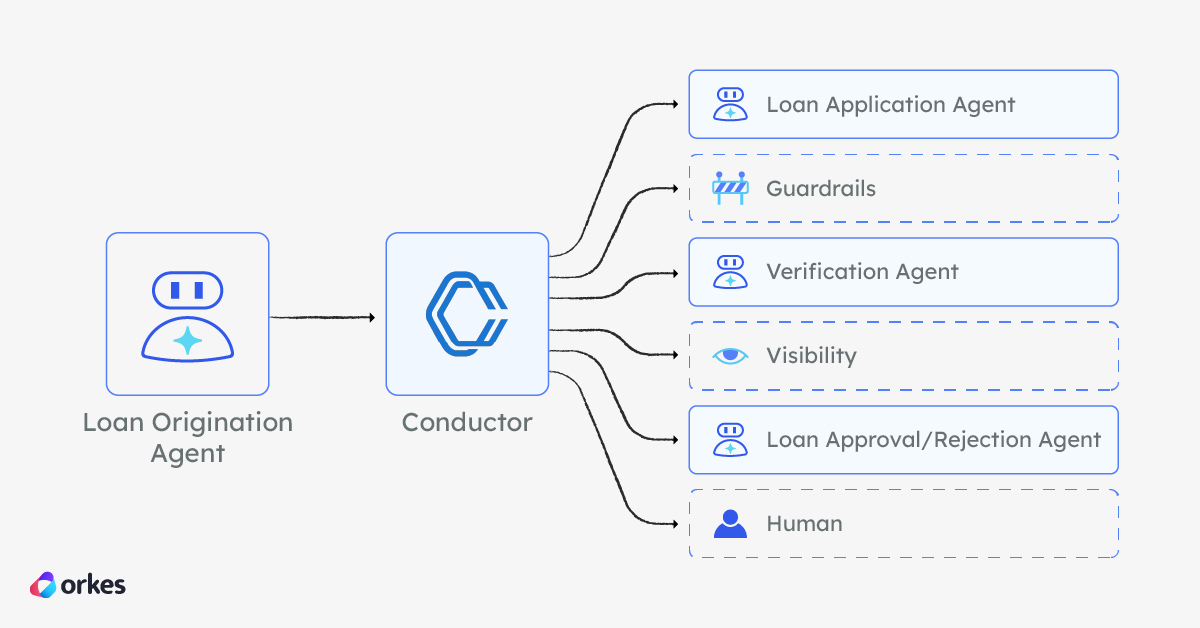
That's because smaller, more focused agents beat a one do-it-all agent on most tasks. Break the big goal into clear chunks. Give each chunk to the agent built for it. Results get sharper. More reliable. Orchestration is the glue that makes the handoffs smooth.
That still leaves the hardest part: trusting your agents to actually do the right thing.
It’s hard to trust AI agents. The models underneath can go off script or confidently make stuff up.
Trust comes from guardrails, structure, checkpoints, and visibility. That’s what orchestration gives you. Track work. Catch mistakes. Sleep at night.
As you scale, you have to become an expert manager. Management is about control, safety, and knowing what’s happening across all those moving parts.
Production-grade management stands on seven pillars:
Guardrails & Policy Enforcement
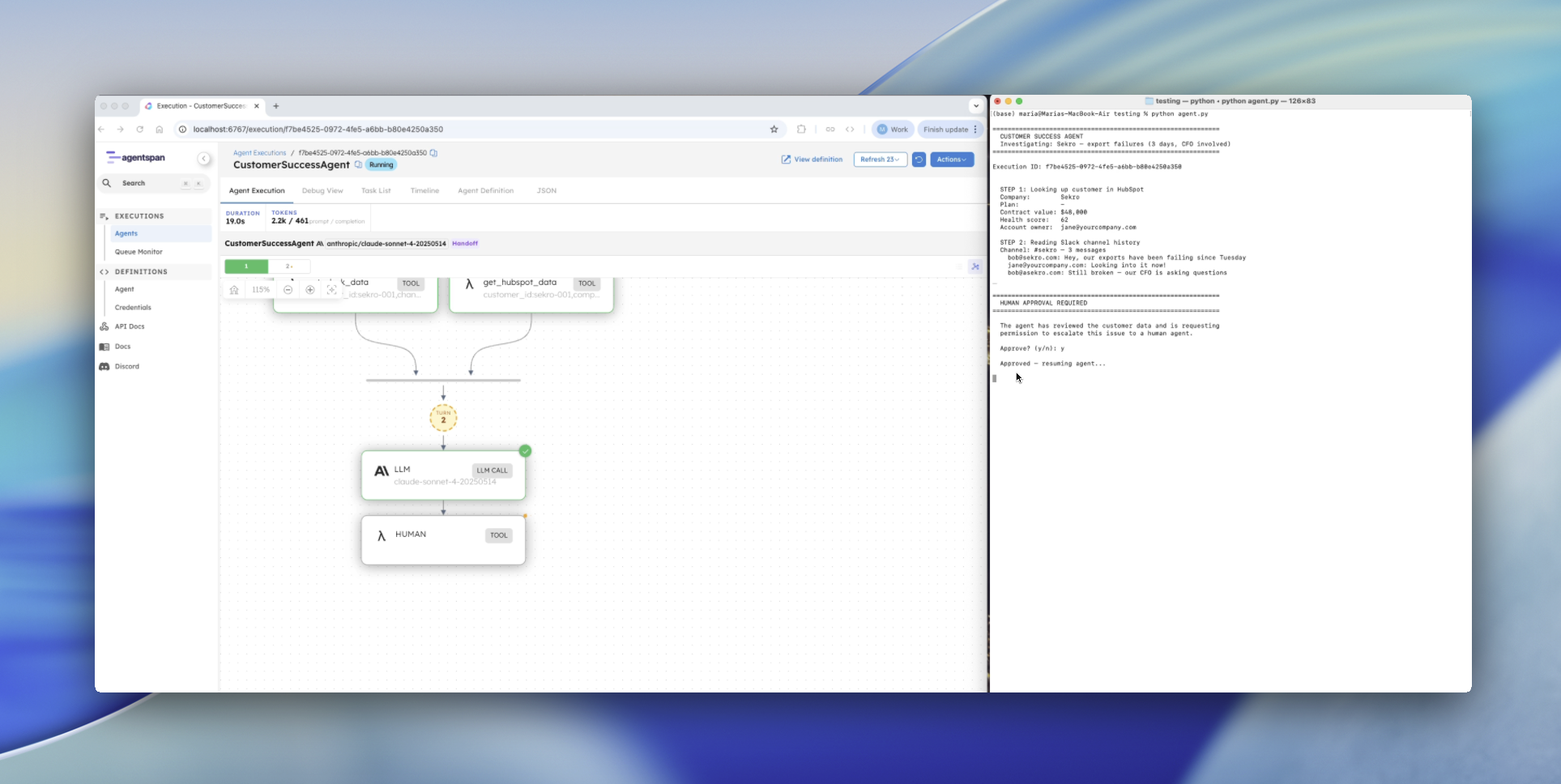
Human-in-the-Loop Moments
Governance Across Agents, Models & Prompts
Role-Based Access Control (RBAC)
Auditing & Traceability
Visibility Into Decisions
Error Handling & Recovery
Managing well is what makes agentic workflows production-ready where you can leverage AI benefits while retaining user trust.
Conductor unifies all seven pillars in a single visual orchestration layer, where you can easily build all the necessary components for a well managed agentic system.

Once you can run an agent reliably, the next step is scaling volume, complexity, and reach. More data, more teams, more use cases. Modularity makes that scale sustainable: smaller interchangeable parts, clear contracts, safer upgrades.
When you think about scaling, one idea is to split your agent into multiple agents and have them communicate with each other. This allows you to have a specialized agent for a specific task, giving you both better results and modularity to your work.
Instead of one mega-agent that does everything, compose three specialists:
Each agent can scale or evolve on its own (new KYC provider? swap the Verification Agent) while Conductor coordinates the entire flow, logs every step, and keeps the SLA intact.
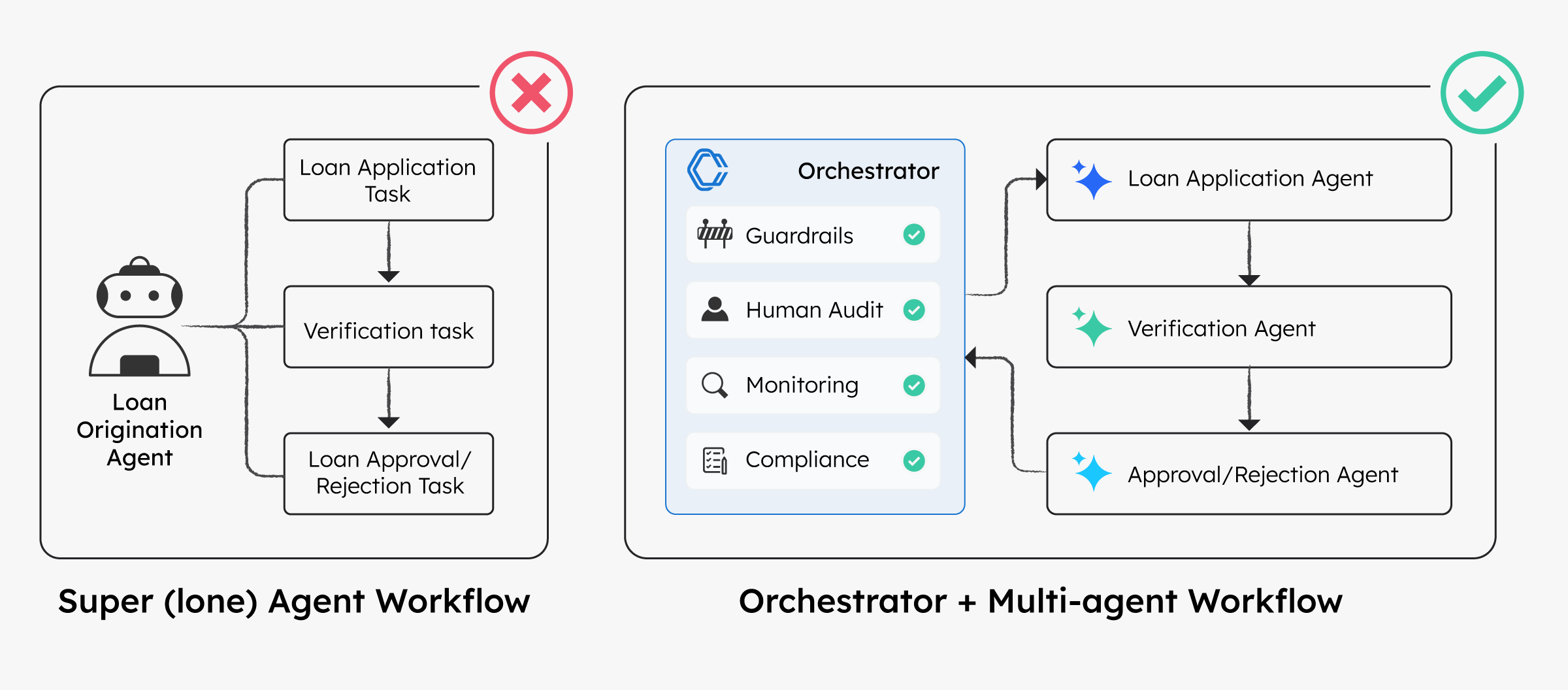
You can do that with Orkes conductor by either having your agent be its own subworkflow, or you can even build your entire agent as a worker if you prefer.
I personally love building the agents as a sub-workflow, and connecting them together as part of a larger workflow, because you can easily take advantage of Orkes Conductor's built-in AI system tasks, AI/LLM and vector database integrations, and AI prompt studio.
Bottom line: small, focused agents plus Conductor’s orchestration layer give you the power to grow from one prototype to an enterprise-grade, multi-agent system—without rewriting the foundation every time you add a feature.
Here are additional ways you can use Conductor to scale your agentic workflows:
Environment Separation
Task and Workflow Registry
Parallel Execution and Decision Making
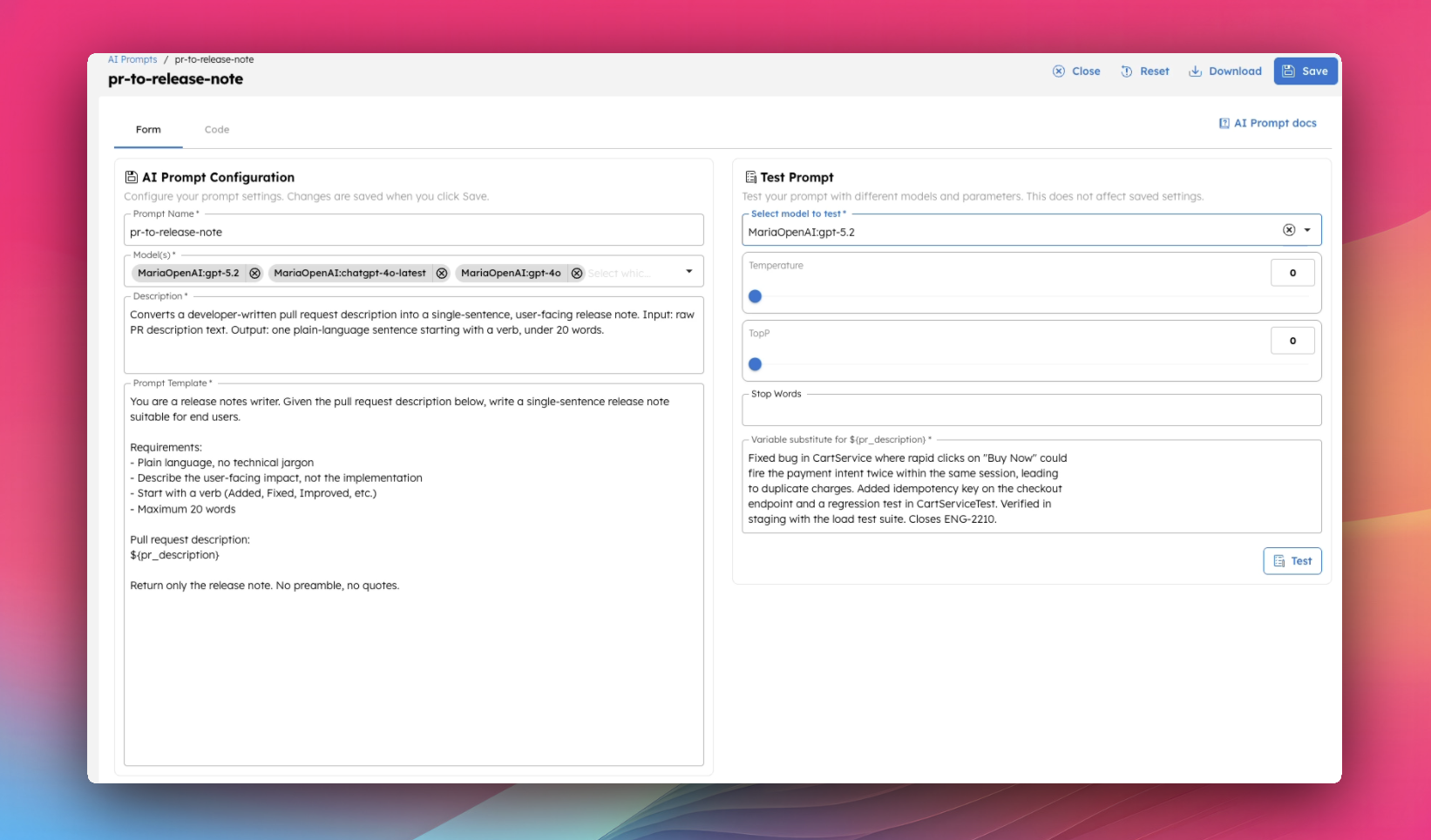
Model and Prompt Lifecycle
Workflows are where the real magic happens, so I will leave you with this: go build one yourself and see just how powerful they can be.
I recommend starting with the Developer Edition's Agentic Research template to see what an agentic workflow looks like. It’s quick to set up and gives you a clear view of how everything flows.