Orkes logo image
Product
Platform
Orkes Platform thumbnail
Orkes Platform
Orkes Agentic Workflows
Orkes Conductor Vs Conductor OSS thumbnail
Orkes vs. Conductor OSS
Orkes Cloud
How Orkes Powers Boat Thumbnail
How Orkes Powers BOAT
Try enterprise Orkes Cloud for free
Enjoy a free 14-day trial with all enterprise features
Start for free
Capabilities
Microservices Workflow Orchestration icon
Microservices Workflow Orchestration
Enable faster development cycles, easier maintenance, and improved user experiences.
Realtime API Orchestration icon
Realtime API Orchestration
Enable faster development cycles, easier maintenance, and improved user experiences.
Event Driven Architecture icon
Event Driven Architecture
Create durable workflows that promote modularity, flexibility, and responsiveness.
Human Workflow Orchestration icon
Human Workflow Orchestration
Seamlessly insert humans in the loop of complex workflows.
Process orchestration icon
Process Orchestration
Visualize end-to-end business processes, connect people, processes and systems, and monitor performance to resolve issues in real-time
Use Cases
By Industry
Financial Services icon
Financial Services
Secure and comprehensive workflow orchestration for financial services
Media and Entertainment icon
Media and Entertainment
Enterprise grade workflow orchestration for your media pipelines
Telecommunications icon
Telecommunications
Future proof your workflow management with workflow orchestration
Healthcare icon
Healthcare
Revolutionize and expedite patient care with workflow orchestration for healthcare
Shipping and logistics icon
Shipping and Logistics
Reinforce your inventory management with durable execution and long running workflows
Software icon
Software
Lorem ipsum dolor sit amet, consectetur adipiscing elit. Aenean leo mauris, laoreet interdum sodales a, mollis nec enim.
Docs
Developers
Learn
Blog
Explore our blog for insights into the latest trends in workflow orchestration, real-world use cases, and updates on how our solutions are transforming industries.
Read blogs
Check out our latest blog:
Conductor CLI Guide: Register, Run, Retry, and Recover Durable Workflows Without Leaving Your Terminal đź’»
Customers
Discover how leading companies are using Orkes to accelerate development, streamline operations, and achieve remarkable results.
Read case studies
Our latest case study:
Twilio Case Study Thumbnail
Orkes Academy New!
Master workflow orchestration with hands-on labs, structured learning paths, and certification. Build production-ready workflows from fundamentals to Agentic AI.
Explore courses
Featured course:
Orkes Academy Thumbnail
Events icon
Events
Videos icons
Videos
In the news icon
In the News
Whitepapers icon
Whitepapers
About us icon
About Us
Pricing
Get a demo
Signup
Slack FaviconDiscourse Logo icon
Get a demo
Signup
Slack FaviconDiscourse Logo icon
Orkes logo image

Company

Platform
Careers
HIRING!
Partners
About Us
Legal Hub
Security

Product

Cloud
Platform
Support

Community

Docs
Blogs
Events

Use Cases

Microservices Workflow Orchestration
Realtime API Orchestration
Event Driven Architecture
Agentic Workflows
Human Workflow Orchestration
Process Orchestration

Compare

Orkes vs Camunda
Orkes vs BPMN
Orkes vs LangChain
Orkes vs Temporal
Twitter or X Socials linkLinkedIn Socials linkYouTube Socials linkSlack Socials linkGithub Socials linkFacebook iconInstagram iconTik Tok icon
© 2026 Orkes. All Rights Reserved.
Back to Blogs

Table of Contents

Share on:Share on LinkedInShare on FacebookShare on Twitter
Worker Code Illustration

Get Started for Free with Dev Edition

Signup
Back to Blogs
PRODUCT ENGINEERING

How to Connect Supabase to Orkes Conductor | Build the Integration Yourself

Maria Shimkovska
Maria Shimkovska
Content Engineer
Last updated: November 6, 2025
November 6, 2025
5 min read

Related Blogs

Connect Supabase and Orkes Conductor in a Couple of Minutes | No Code Needed

Nov 5, 2025

Connect Supabase and Orkes Conductor in a Couple of Minutes | No Code Needed

Discover how easy it is to build your own personalized AI agent! This hands-on guide walks you through the basics; then shows you how to create a fun, tool-using ghost chatbot to make it your own.

Oct 31, 2025

Discover how easy it is to build your own personalized AI agent! This hands-on guide walks you through the basics; then shows you how to create a fun, tool-using ghost chatbot to make it your own.

RBAC: Protect Your Workflows from Unauthorized Access and Terrors

Oct 7, 2025

RBAC: Protect Your Workflows from Unauthorized Access and Terrors

Ready to Build Something Amazing?

Join thousands of developers building the future with Orkes.

Start for free

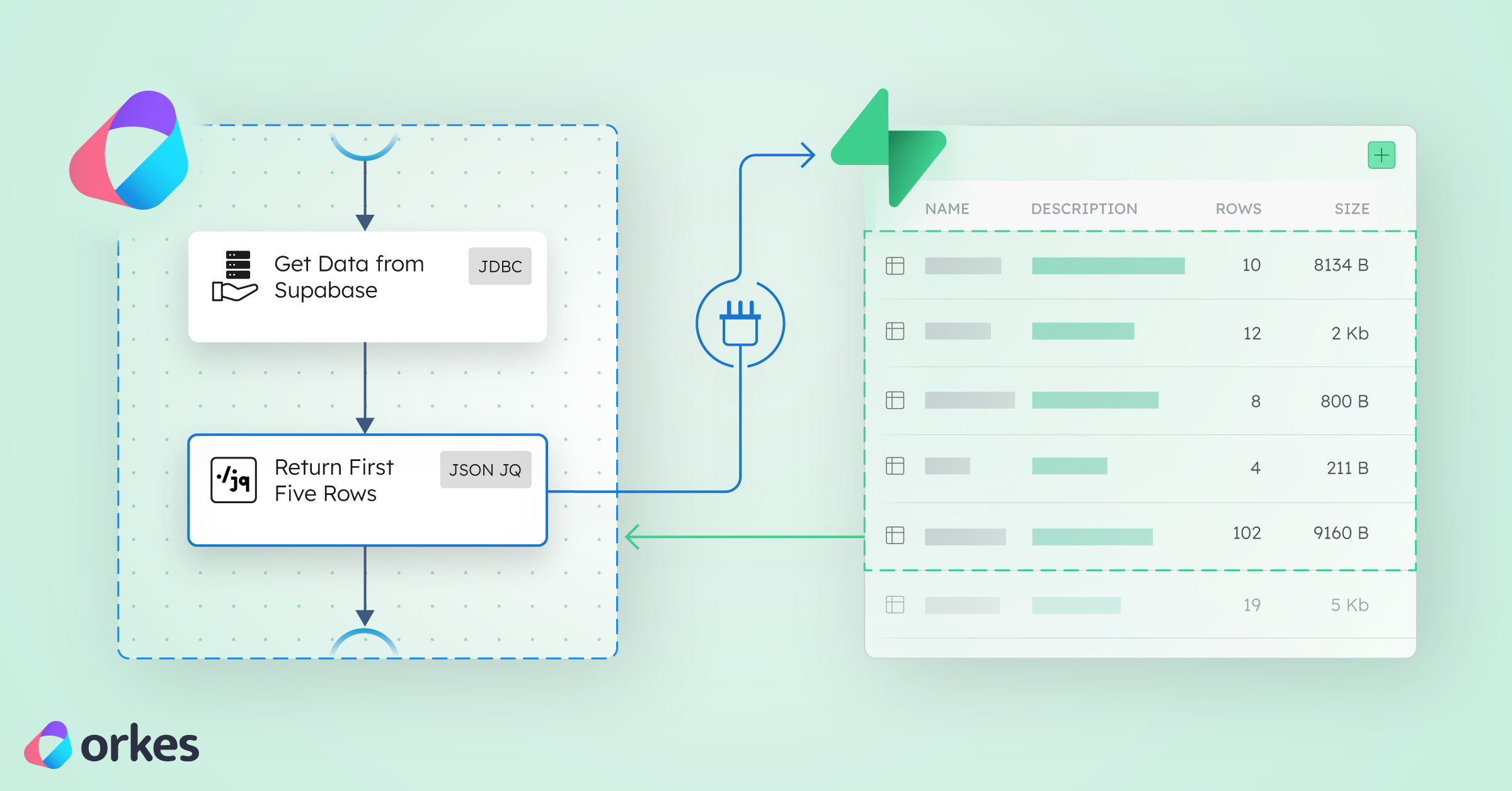
Behind the scenes of the Supabase automation template. How to connect your database to Orkes Conductor from scratch.

TL;DR
  • Create a JDBC integration in Orkes Conductor.
  • Use your Supabase connection string and credentials.
  • Run a simple SQL query using a JDBC task.
  • Chain tasks into a workflow to automate your Supabase data.

Cover illustration showing the connection between Orkes Conductor and Supabase.

Why Build It Yourself

Our Supabase + Orkes Template lets you connect Supabase in seconds but if you want to understand how it works, or customize it for yourself, this guide shows exactly how to build that connection manually in Orkes Conductor.

By the end, you will have a workflow that reads your Supabase data and processes it in Orkes Conductor using nothing but:

  • A database URL
  • One SQL query
  • Two system tasks

Step 0: Make Sure You Have a Supabase Database Ready

Before connecting Orkes to Supabase, you need a database with at least one table.

If you don’t have one:

  1. Go to supabase.com → Create a project
  2. Open the SQL editor
  3. Create a simple table, for example:
sql
CREATE TABLE public.my_table (
  id SERIAL PRIMARY KEY,
  note TEXT,
  created_at TIMESTAMP DEFAULT NOW()
);

Once this exists, you can connect Orkes directly to it.

Step 1: Get Your Supabase Connection Details

Inside your Supabase project:

  1. On the top of the screen you'll see Connect button. Click that.
  2. Copy your Direct Postgres connection string (This is important; we are not using the transaction pooler)

It will look like this:

bash
postgresql://postgres:<password>@<project>.supabase.co:5432/postgres

To use it in Orkes, convert it into a JDBC format:

bash
jdbc:postgresql://<project>.supabase.co:5432/postgres

Keep your Host, Port (5432), Username (postgres), Password, Database name (postgres by default) handy. You’ll paste these into Orkes next.

Step 2: Create a JDBC Integration in Orkes

This is what lets Conductor talk to Supabase.

  1. Log into your Orkes Developer Edition
  2. Go to Integrations → New Integration → Relational Database
  3. Name it something meaningful, like supabase_connection
  4. Choose database type: Postgres
  5. Paste your JDBC connection string (example: jdbc:postgresql://<project>.supabase.com:5432/postgres)
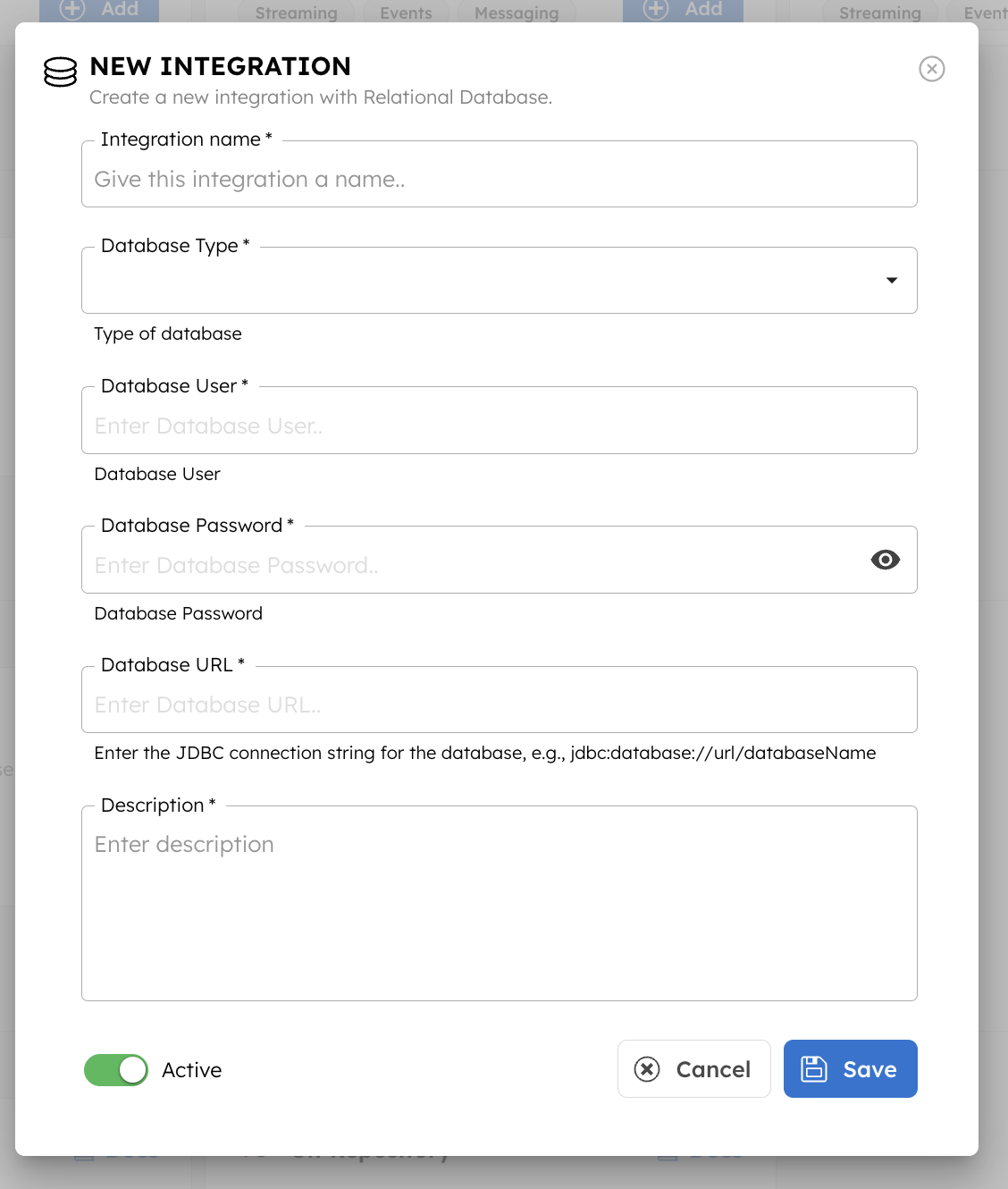
  6. Enter your Supabase database username and password (and a description of the integration)
  7. Click Save

Cover illustration showing the connection between Orkes Conductor and Supabase.

That’s it. Orkes can now talk to your Supabase database. Sweet! 🥳

Step 3: Create a Workflow That Runs Your First SQL Query

Now let’s make sure everything works by creating your JDBC workflow.

  1. Go to Workflows → Create Workflow
  2. Name it something like SupabaseConnectorManual
  3. Add a JDBC task
  4. Set the integration to the one you created (supabase_connection)
  5. In SQL, query your table. For example:
sql
SELECT * FROM public.my_table;
  1. Set the type to SELECT

This task will fetch rows directly from Supabase.

Next, add a second task to inspect the data.

Add a JSON → JQ Transform Task

  1. Add a new task JSON_JQ_TRANSFORM
  2. Name it processData
  3. Paste this JQ expression:
json
{
  "queryExpression": "{first_rows: .getAllData_ref.output.result[:5]}"
}

This pulls the first 5 rows from your Supabase table so you can preview the results easily.

Your final workflow definition should look like this:

json
{
{
  "name": "SupabaseConnectorManual",
  "description": "Fetches and processes Supabase data through Orkes Conductor",
  "version": 1,
  "tasks": [
    {
      "name": "getAllData",
      "taskReferenceName": "getAllData_ref",
      "type": "JDBC",
      "inputParameters": {
        "integrationName": "supabase_connection",
        "statement": "SELECT * FROM public.my_table",
        "type": "SELECT"
      }
    },
    {
      "name": "processData",
      "taskReferenceName": "processData_ref",
      "type": "JSON_JQ_TRANSFORM",
      "inputParameters": {
        "queryExpression": "{first_rows: .getAllData_ref.output.result[:5]}"
      }
    }
  ],
  "schemaVersion": 2
}

That’s the entire pipeline; a clean example of "query → transform" using Orkes.

Step 5: Extend and Automate

Once your connection works, you can:

  • Use AI tasks to summarize your data or do any cool AI thing with it.
  • Use HTTP tasks to send data to Slack if you want to build a slack bot using your own data.
  • Use SendGrid tasks to email daily reports.
  • use more JDBC tasks to write results back into Supabase.

This is how your workflow evolves from “just run SQL” into full-blown automation.

Why I'm Using the Direct Postgres Connection (5432) Instead of the Transaction Pooler (6543)

For this Orkes Conductor setup, I’m intentionally using the direct Postgres connection (5432) because Conductor often runs many tasks at once, and each JDBC task opens its own database connection.

Supabase’s transaction pooler (6543) only allows a small number of clients — usually 10–20 — so it quickly throws FATAL: Max client connections reached when multiple tasks run in parallel. (This might be different for the paid versions. But I wanted to make this free.)

The direct connection gives Postgres far more room, making it stable and reliable for workflow systems.

Wrapping Up: From Database Connection to Automation

At this point you can:

  • Connect Supabase to Orkes reliably
  • Run SQL from inside a workflow
  • Inspect, transform, or enrich results
  • Trigger downstream automations

And when you want to skip the setup, the Supabase Automation Template is waiting for you, but now you know exactly how it works under the hood.