Orkes logo image
Product
Platform
Orkes Platform thumbnail
Orkes Platform
Orkes Agentic Workflows
Orkes Conductor Vs Conductor OSS thumbnail
Orkes vs. Conductor OSS
Orkes Cloud
How Orkes Powers Boat Thumbnail
How Orkes Powers BOAT
Try enterprise Orkes Cloud for free
Enjoy a free 14-day trial with all enterprise features
Start for free
Capabilities
Microservices Workflow Orchestration icon
Microservices Workflow Orchestration
Enable faster development cycles, easier maintenance, and improved user experiences.
Realtime API Orchestration icon
Realtime API Orchestration
Enable faster development cycles, easier maintenance, and improved user experiences.
Event Driven Architecture icon
Event Driven Architecture
Create durable workflows that promote modularity, flexibility, and responsiveness.
Human Workflow Orchestration icon
Human Workflow Orchestration
Seamlessly insert humans in the loop of complex workflows.
Process orchestration icon
Process Orchestration
Visualize end-to-end business processes, connect people, processes and systems, and monitor performance to resolve issues in real-time
Use Cases
By Industry
Financial Services icon
Financial Services
Secure and comprehensive workflow orchestration for financial services
Media and Entertainment icon
Media and Entertainment
Enterprise grade workflow orchestration for your media pipelines
Telecommunications icon
Telecommunications
Future proof your workflow management with workflow orchestration
Healthcare icon
Healthcare
Revolutionize and expedite patient care with workflow orchestration for healthcare
Shipping and logistics icon
Shipping and Logistics
Reinforce your inventory management with durable execution and long running workflows
Software icon
Software
Lorem ipsum dolor sit amet, consectetur adipiscing elit. Aenean leo mauris, laoreet interdum sodales a, mollis nec enim.
Docs
Developers
Learn
Blog
Explore our blog for insights into the latest trends in workflow orchestration, real-world use cases, and updates on how our solutions are transforming industries.
Read blogs
Check out our latest blog:
How to Build a Durable Conductor Workflow using Conductor Skills and Claude Code in Minutes
Customers
Discover how leading companies are using Orkes to accelerate development, streamline operations, and achieve remarkable results.
Read case studies
Our latest case study:
Twilio Case Study Thumbnail
Orkes Academy New!
Master workflow orchestration with hands-on labs, structured learning paths, and certification. Build production-ready workflows from fundamentals to Agentic AI.
Explore courses
Featured course:
Orkes Academy Thumbnail
Events icon
Events
Videos icons
Videos
In the news icon
In the News
Whitepapers icon
Whitepapers
About us icon
About Us
Pricing
Get a demo
Signup
Slack FaviconDiscourse Logo icon
Get a demo
Signup
Slack FaviconDiscourse Logo icon
Orkes logo image

Company

Platform
Careers
HIRING!
Partners
About Us
Legal Hub
Security

Product

Cloud
Platform
Support

Community

Docs
Blogs
Events

Use Cases

Microservices Workflow Orchestration
Realtime API Orchestration
Event Driven Architecture
Agentic Workflows
Human Workflow Orchestration
Process Orchestration

Compare

Orkes vs Camunda
Orkes vs BPMN
Orkes vs LangChain
Orkes vs Temporal
Twitter or X Socials linkLinkedIn Socials linkYouTube Socials linkSlack Socials linkGithub Socials linkFacebook iconInstagram iconTik Tok icon
© 2026 Orkes. All Rights Reserved.
Back to Blogs

Table of Contents

Share on:Share on LinkedInShare on FacebookShare on Twitter
Worker Code Illustration

Get Started for Free with Dev Edition

Signup
Back to Blogs
PRODUCT

Fail Fast, Recover Smart: Timeouts, Retries, and Recovery in Orkes Conductor

Karl Goeltner
Karl Goeltner
Software Engineer
Last updated: May 12, 2025
May 12, 2025
5 min read

Related Blogs

Task-Level Resilience in Orkes Conductor: Timeouts and Retries in Action

May 12, 2025

Task-Level Resilience in Orkes Conductor: Timeouts and Retries in Action

Workflow-Level Resilience in Orkes Conductor: Timeouts and Failure Workflows

May 12, 2025

Workflow-Level Resilience in Orkes Conductor: Timeouts and Failure Workflows

Control the Flow: Building Dynamic Workflows with Orkes Operators

Apr 28, 2025

Control the Flow: Building Dynamic Workflows with Orkes Operators

Ready to Build Something Amazing?

Join thousands of developers building the future with Orkes.

Start for free

In distributed systems, failure isn’t a possibility—it’s a certainty. APIs hang, workers crash, and networks drop. What matters isn’t avoiding failure, but recovering from it quickly and cleanly.

Orkes Conductor gives you the tools to do exactly that. Timeouts and retries aren’t just configurable—they’re core to how Conductor ensures reliability at scale. In this post, you’ll learn how to use them effectively at both the task and workflow levels, how they interact with failure workflows, and how to design resilient systems that heal themselves without manual intervention.

Let’s dive in.

Why failure handling is critical in workflow applications

Imagine you're orchestrating a payment flow. After the user places an order, your workflow triggers tasks to charge the card, update inventory, and send a confirmation email.

All good—until the inventory API goes silent.

Now you're in a mess: the card is charged, but inventory isn’t updated, and the user doesn’t get a confirmation. This is exactly the kind of situation timeouts and retries are designed to avoid.
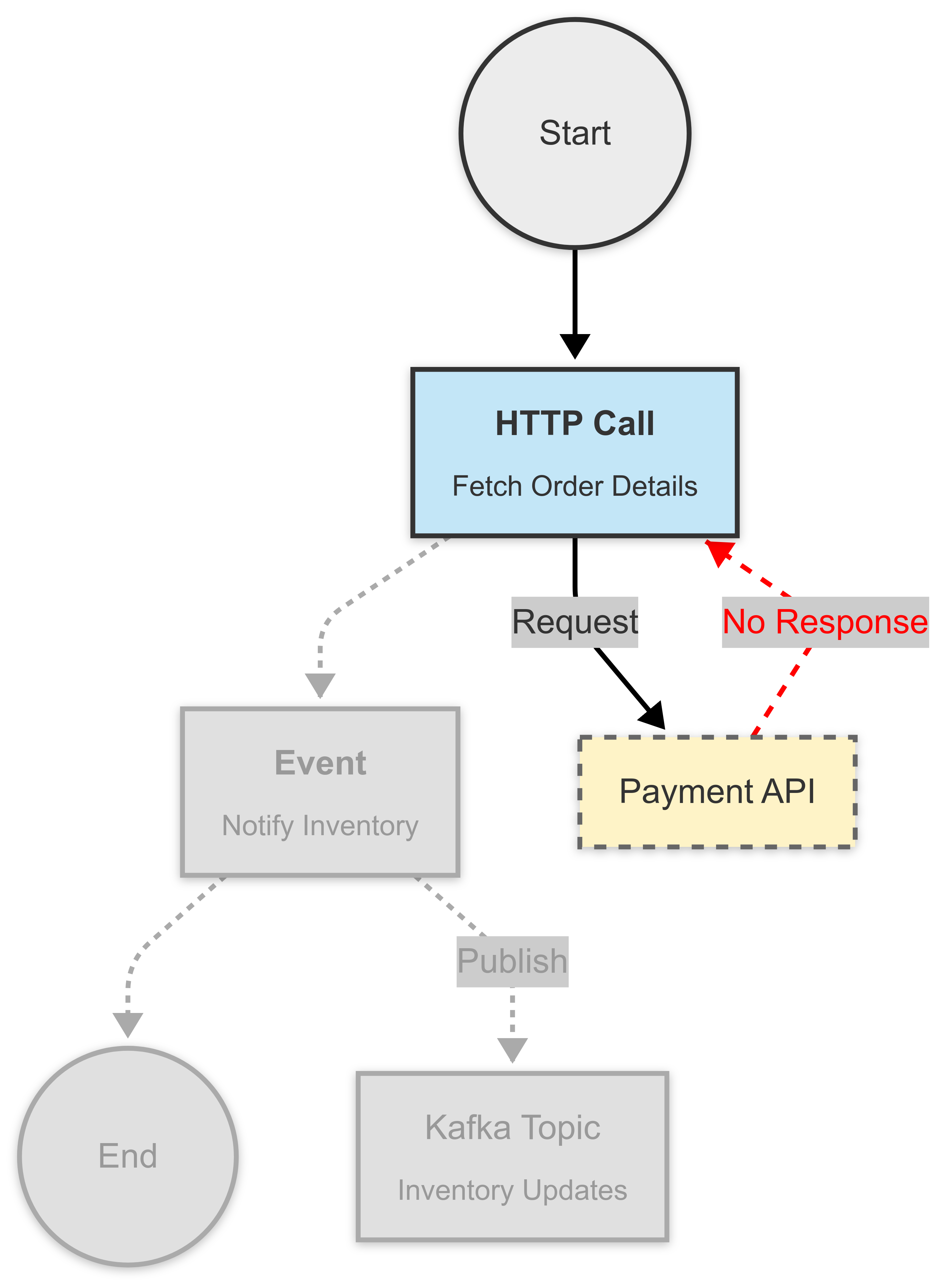
Unresponsive HTTP task in an inventory workflow

Unresponsive HTTP task in an inventory workflow

In Orkes Conductor, timeouts and retries work together to provide resilience and control:

  • Timeouts prevent your workflow from hanging indefinitely.
  • Retries recover from transient errors without manual intervention.

Together, they help you gracefully handle:

  • Unresponsive services: If a downstream API is taking too long, timeout the task and retry or move on.
  • Crashed or unresponsive workers: If a worker crashes mid-task, timeouts ensure the task doesn’t hang forever.
  • Transient errors: If a task fails quickly (like a network blip or 500 error), retries can automatically reattempt the operation.
  • Misconfigured or under-provisioned systems: If no worker is available to pick up a task, timeouts ensure the system doesn’t just wait forever.

This is more than resilience—it’s control. Instead of writing custom error-handling logic for every edge case, you get:

  • At-least-once delivery
  • Automatic retry logic
  • Configurable timeouts
  • Self-healing workflows

Task timeouts vs task retries

As you design resilient workflows, it’s important to understand the difference between timeouts and retries for individual tasks—they solve different problems:

AspectRetryTimeout
What it isA second (or third, etc.) attempt to run the same task after it fails.A time limit for how long a task is allowed to run (or how long you wait for it to start/progress).
TriggerHappens after a task fails (e.g., returns FAILED).Happens if the task takes too long to respond to or complete.
ExampleAPI call fails with 500 Internal Server Error → Retry it after a delay.API call hangs with no response after 30 seconds → Timeout triggers a recovery action.
Configured viaretryCount, retryLogic, retryDelaySeconds, backoffScaleFactortimeoutSeconds, pollTimeoutSeconds, responseTimeoutSeconds, timeoutPolicy

In short:

  • Retries deal with tasks that fail fast.
  • Timeouts deal with tasks that hang slow.

Both are essential for robust, fault-tolerant tasks.
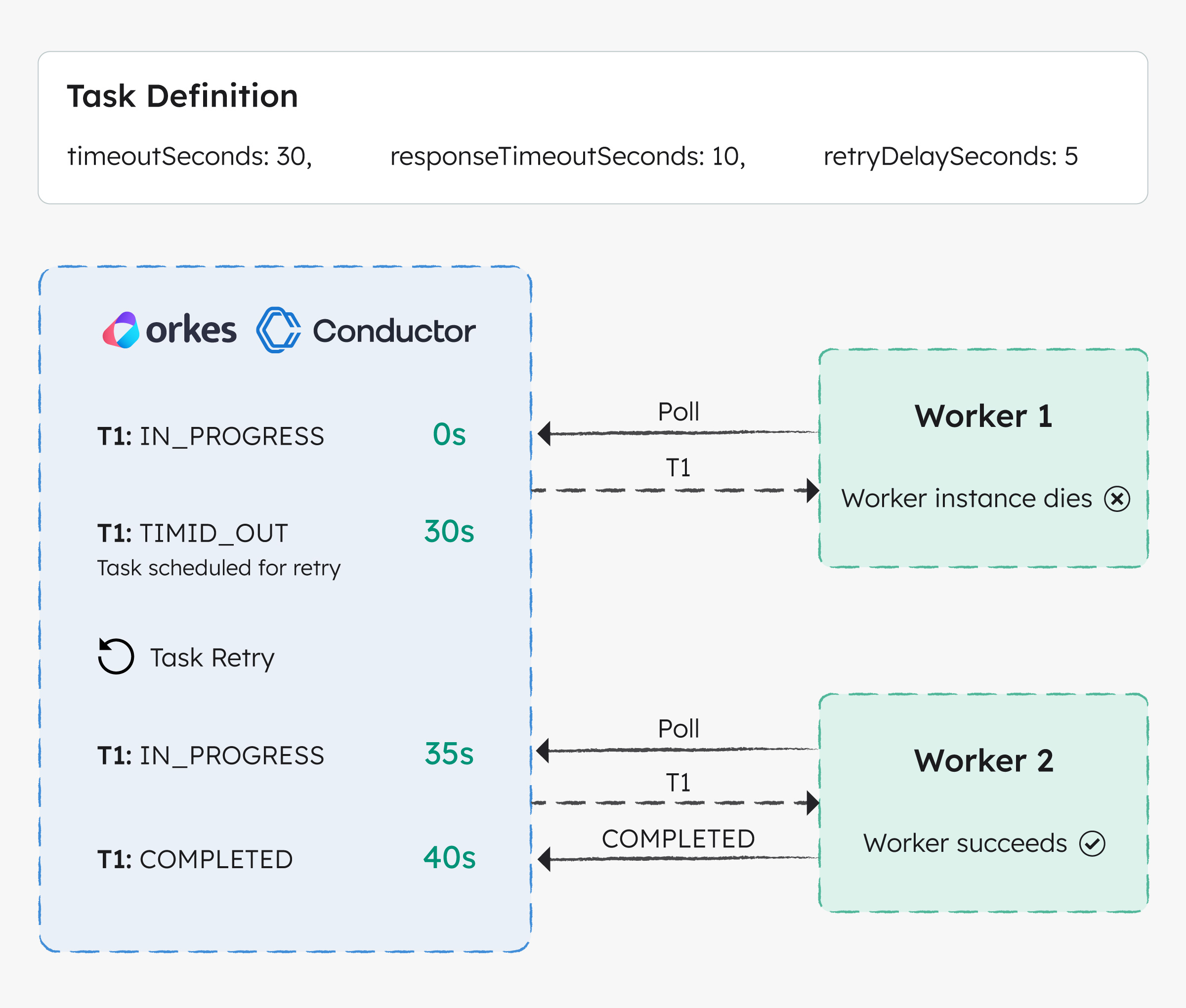
Task timeouts vs task retries

Failed worker resulting in task-timeout and retries

Workflow timeouts and failure workflows

Just like tasks, entire workflows can time out or fail, and Conductor gives you powerful tools to handle those cases gracefully.

AspectWorkflow TimeoutFailure Workflow
What it isA maximum time limit for the whole workflow to complete.A backup workflow that runs automatically when the original workflow fails.
TriggerHappens when the workflow exceeds its configured timeout.Happens when the workflow ends in FAILED or TERMINATED status.
ExampleA data pipeline takes too long (e.g., > 2 hours) → Workflow is marked TIMED_OUT.A workflow fails due to repeated task failures → A failure workflow sends alerts and logs diagnostics.
Configured viatimeoutSeconds, timeoutPolicyfailureWorkflow

In short:

  • Workflow timeouts protect against indefinitely running flows.
  • Failure workflows let you define recovery logic and postmortems for failed flows.

Together, they make workflows self-aware and recoverable.
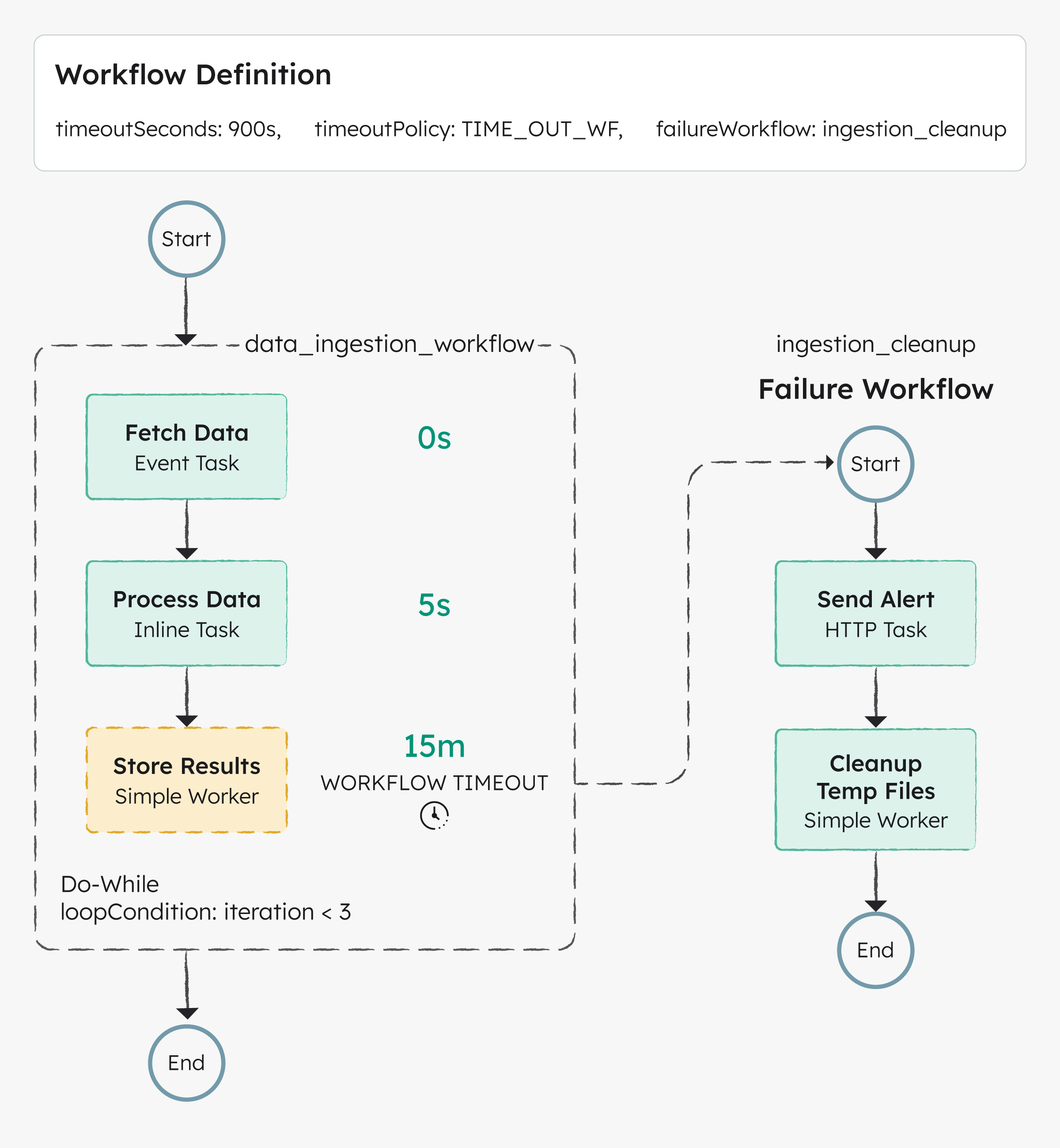
Workflow timeouts and failure workflows

Long-running worker exceeds workflow timeout and triggers compensation workflow

Combining retries, timeouts, and failure Workflows

Retries give tasks more chances. Timeouts limit how long each attempt can run. Workflow timeouts cap the total duration of the workflow. If all else fails, failure workflows take over.

Here’s how it all fits together:

  • Task fails → Task Retry: it’s retried (up to retryCount).
  • Each retry has a timeout → Task Timeout: Limits how long you wait per attempt.
  • Too many failures or long delay → Workflow Timeout: Workflow fails or times out.
  • Workflow fails → Failure Workflow: A failure workflow runs to clean up or alert.

This layered approach gives you fault-tolerance at every level:
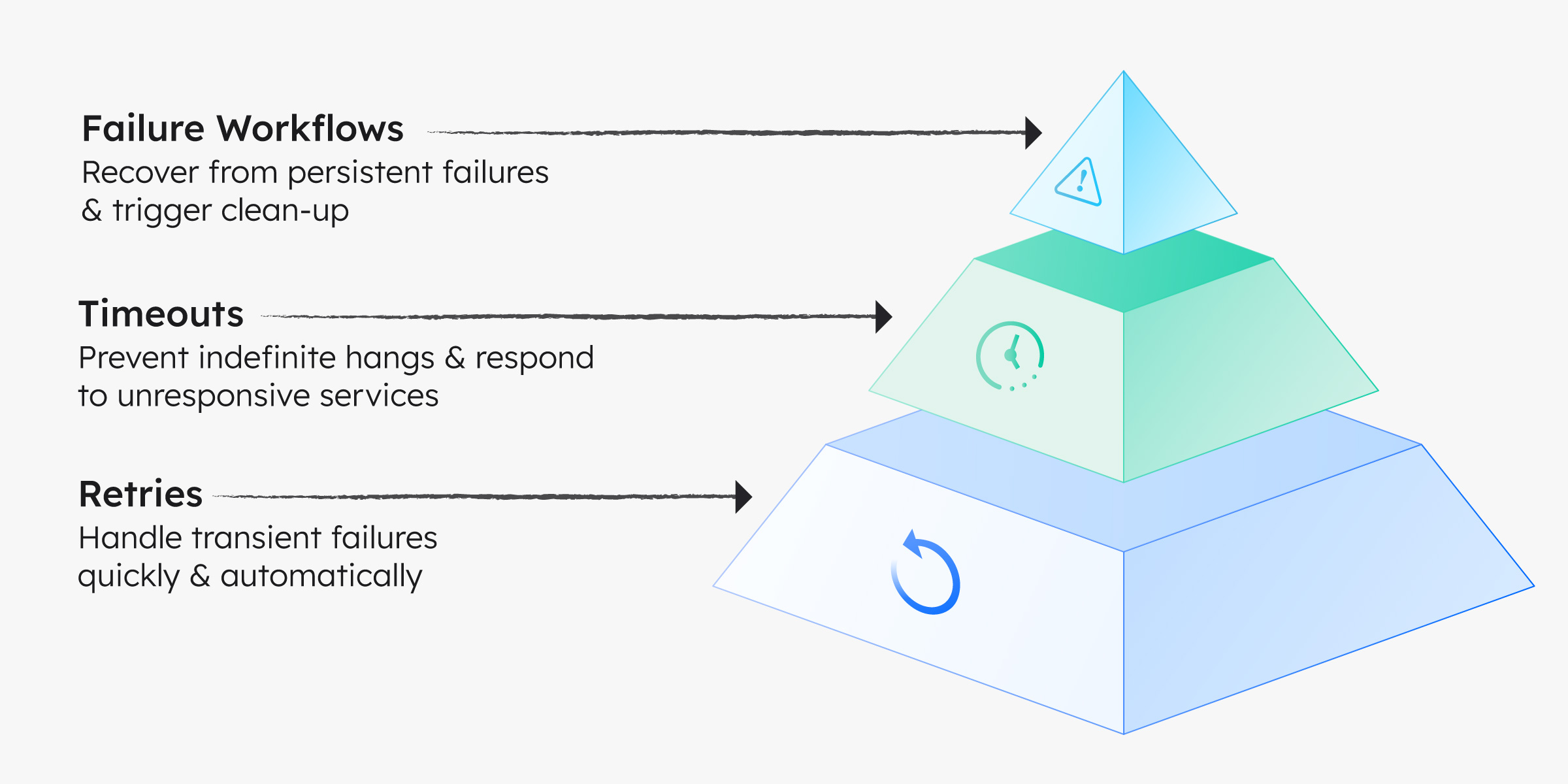
Resilience pyramid

Default vs custom configuration: When to override

Orkes Conductor ships with sane defaults.

Task retry settings

json
{
  "retryCount": 3,
  "retryDelaySeconds": 60,
  "retryLogic": "FIXED",
  "backoffScaleFactor": 1
}

Task timeout settings

json
{
  "responseTimeoutSeconds": 600,
  "timeoutSeconds": 3600,
  "pollTimeoutSeconds": 3600,
  "timeoutPolicy": "TIME_OUT_WF"
}

Workflow settings

json
{
  "timeoutSeconds": 0,
  "timeoutPolicy": "ALERT_ONLY",
  "failureWorkflow": ""
}

These are a solid starting point, but not always ideal for your SLAs.

Override the defaults when:

  • You have strict latency goals, such as completing checkout in under 5 minutes.
  • You interact with unreliable third-party APIs, like a flaky partner API.
  • You need predictable system behavior under load or failure.

On the flip side, don’t override just for the sake of it. Defaults help reduce configuration sprawl and are good enough for many internal service workflows.

Wrap up

In distributed systems, failure is inevitable, but downtime doesn’t have to be. With Orkes Conductor, resilience is built in, not bolted on.

Timeouts help prevent indefinite hangs, and retries offer automatic recovery from transient issues. Workflow-level timeouts and failure workflows ensure your entire system can fail gracefully and bounce back, without manual intervention.

By combining these tools thoughtfully, you get more than reliability—you get confidence—confidence that your workflows will keep running, even when parts of your system don’t.

So, whether you're orchestrating high-stakes payment flows or background data pipelines, remember: design for failure, recover automatically, and keep moving forward.

Go more in-depth with task and workflow resilience with these follow-up articles:

  • Task-Level Resilience
  • Workflow-Level Resilience

—

Orkes Conductor is an enterprise-grade orchestration platform for process automation, API and microservices orchestration, agentic workflows, and more. Check out the full set of features, or try it yourself using our free Developer Edition.