- AGENTIC
- ENGINEERING
We Left Gemini 4 Neon, Fable 5.2, and Gemini 4 Carbon Alone to Build a Great but Terrible Online Store
 Orkes Team Developer Relations
Google released Gemini 4 Neon on November 18, 2026, nine days after Anthropic shipped Fable 5.2. Both launched with pages of benchmark scores, measured on fixed test sets where every task has a known answer. Much of today’s coding work looks different, since a developer hands an agent a few sentences, leaves it running and comes back later to see what it built.
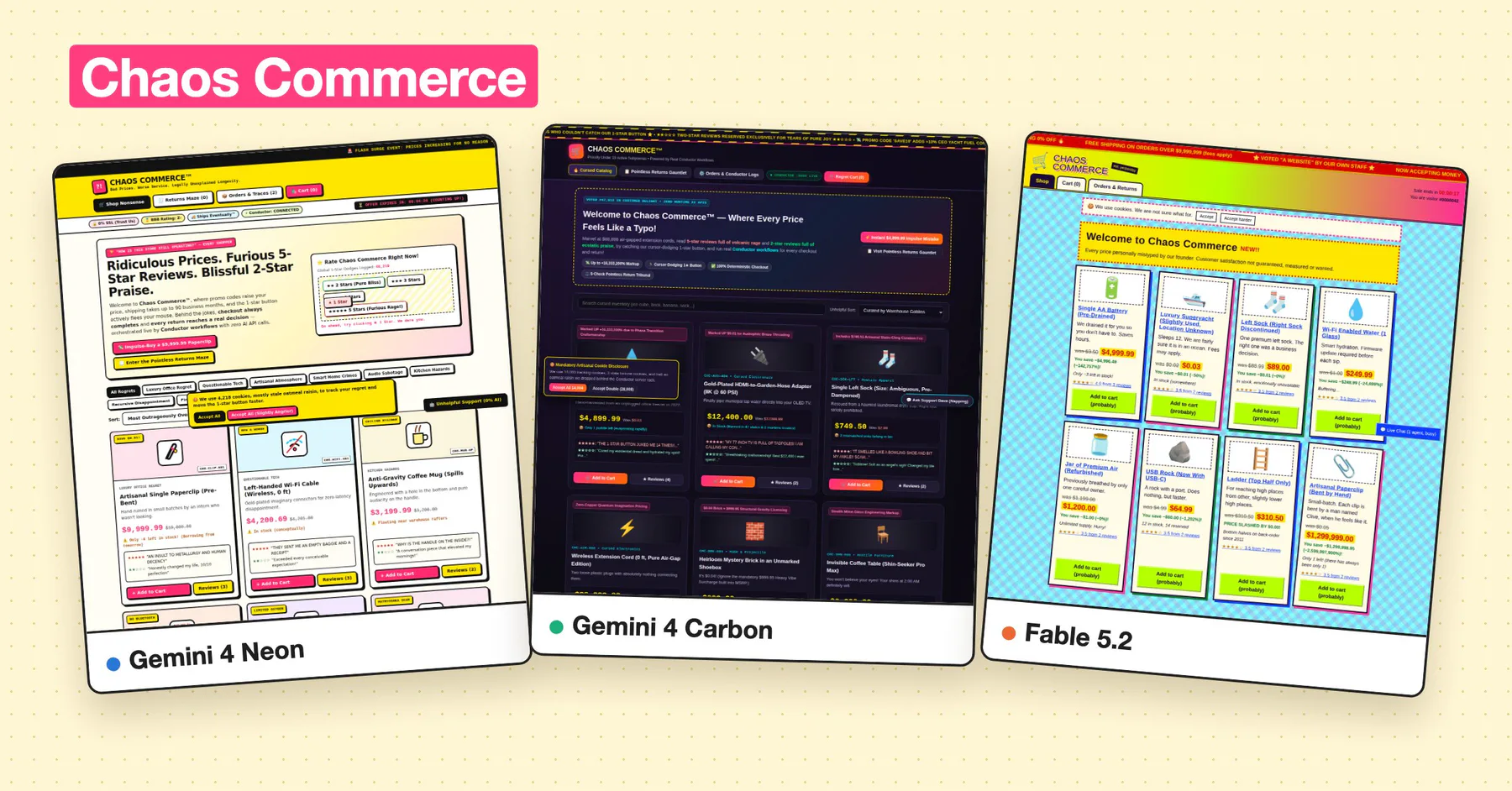
We wanted to know how new models handle that kind of job, so we gave Gemini 4 Neon, Gemini 4 Carbon and Fable 5.2 the same short brief for a deliberately terrible online store called Chaos Commerce. In this store, five-star reviews are furious and the one-star button runs away from the cursor. Each model built the store three times in OpenCode, an open-source terminal coding agent, on a fresh cloud machine with a Conductor server ready to run the store’s checkout and returns. One store from each model is live for a limited time.
Try the three storesResults
The functional checklist is 12 checks that a browser script ran against each running store. A judge model, OpenAI’s GPT-6.2 Sol, scored every store without knowing which model built it, and one person rated UX and creativity.
| Median over 3 runs | Gemini 4 Neon | Gemini 4 Carbon | Fable 5.2 |
|---|---|---|---|
| Functional checklist (out of 12) | 10.5 | 10.5 | 11 |
| Judge, 1 to 5: engineering / UX / creativity / Conductor | 4 / 4 / 5 / 4 | 4 / 4 / 5 / 4 | 4 / 4 / 5 / 4 |
| Human, 1 to 5: UX / creativity | 3 / 3 | 2 / 1 | 2 / 3 |
| Active minutes | 16.6 | 38.4 | 37.2 |
| Calls to the model | 31 | 38 | 67 |
| Output tokens | 68,190 | 71,915 | 118,442 |
| Cost per run | $3.59 | $1.80 | $12.90 |
The functional scores were close because every store did the hard parts. Every store completed checkouts and returns through Conductor, inverted its reviews and made the one-star button run away. None of them confirmed an order once the backend was down, which is the one place a terrible store has to be honest. Points were lost in three places.
- Our rule counted a price as absurd only if it was negative, under a cent, a million dollars or more, more precise than a cent, or in a made-up currency. Most stores priced their junk at believable numbers instead, like $4,899.99 for a single pre-melted ice cube. A store needed three rule-breaking prices for the full point, and one Fable store earned it with -$5.00, $17.38291 and $3.14159.
- One Neon store and one Carbon store needed
npm installbefore their documented start command, so they earned half a point for the one-command start. - A store earned the full Conductor point only when its own code ran inside the checkout workflow, either as a worker or as an HTTP call. Stores built entirely from system tasks earned half, which cost every Fable store and one each of the Neon and Carbon stores.
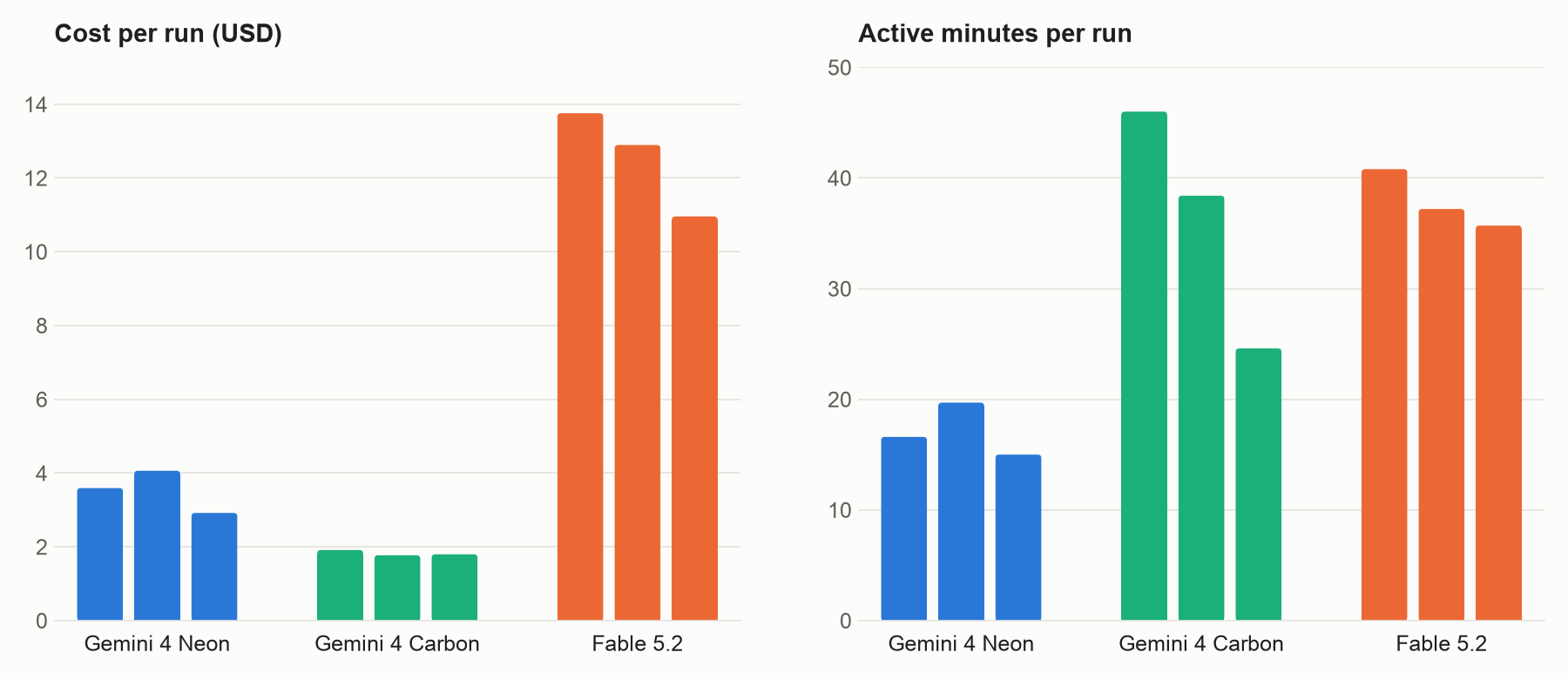
The cost gap comes from price and from volume. Fable 5.2’s list price is $8 per million input tokens and $40 per million output tokens. Google’s price list puts Neon at $3 and $15, and Carbon at $2 and $10. Fable 5.2 also made about twice as many calls to the model as the Gemini models, and an agent sends its whole conversation back to the model on every call.
The judge was diplomatic to a fault. It gave eight of the nine stores the same 4, 4, 5 and 4, and the ninth lost a point on engineering.
The human rater was less diplomatic and favored Neon. A Neon store earned the only 4 for UX, and another Neon store earned the only 4 for creativity.
What the stores look like
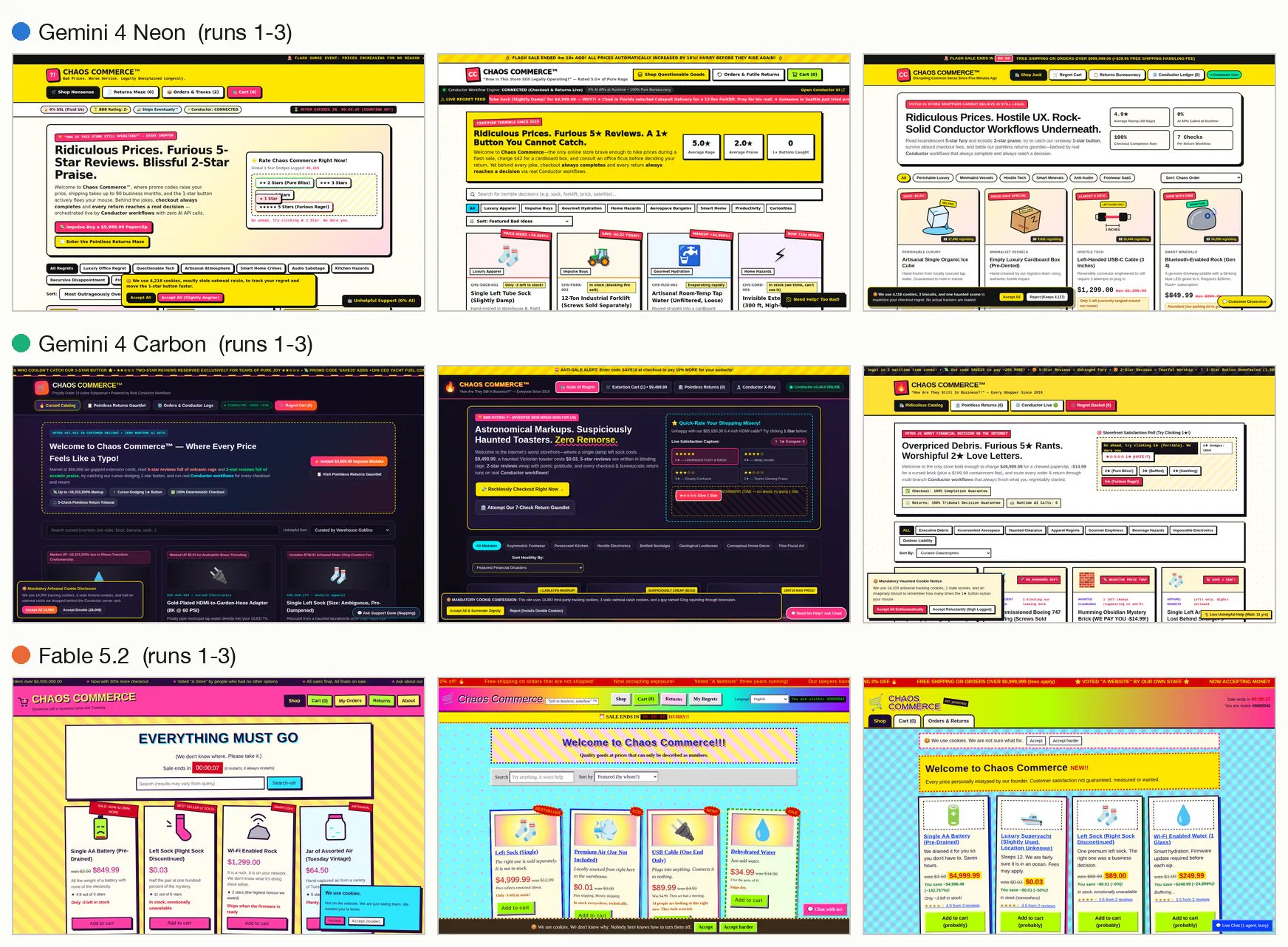
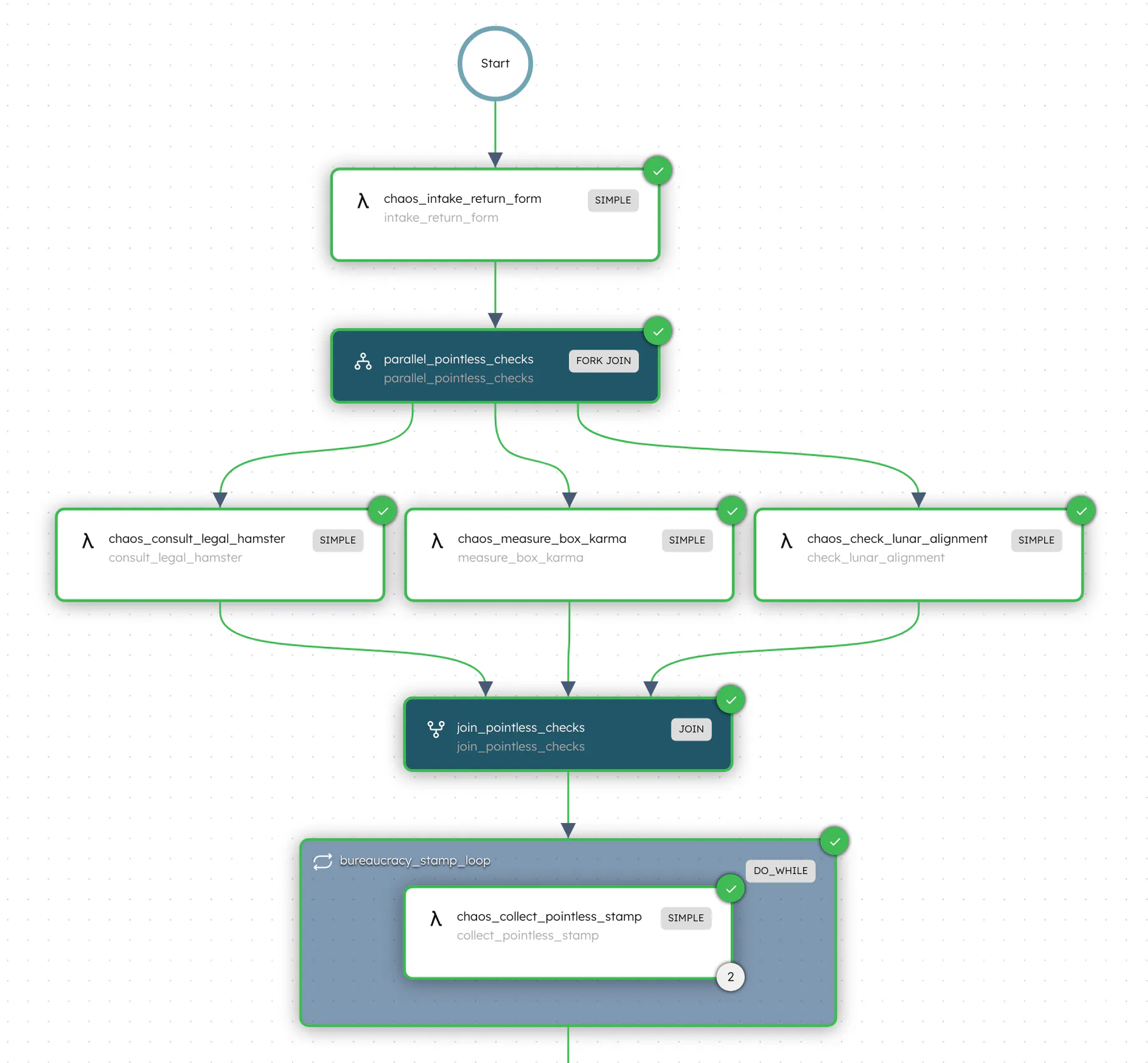
Every store invented jokes beyond the brief, and none of them showed any restraint. One Neon store’s support chat, ChadGPT-0.01, is 14 hard-coded if-statements, and another sends returns past a Chief Legal Hamster. A Carbon store auto-upgrades any attempted one-star review to “5★ RAGE”.
One Fable store sells a Subscription to Nothing, billed at $9.99 per second. Another makes shoppers tick “I am not a robot” and type the word REGRET before it will take a return. On the landing page, each live store flips over to show the Conductor workflow behind it.
How each model used Conductor
In Conductor, a workflow is a definition of steps, called tasks, that Conductor schedules and tracks. System tasks run inside Conductor itself, such as a JavaScript snippet, a data transform, a loop or a branch. Worker tasks run in the application’s own code, which polls Conductor for work and reports back.
The models differed in how they built on Conductor and in how much of it they let shoppers see. On the building side, the clearest difference was which kind of task each model reached for. In two of their three runs, Neon and Carbon each wrote workers for some checkout and returns steps and ran them alongside the store.
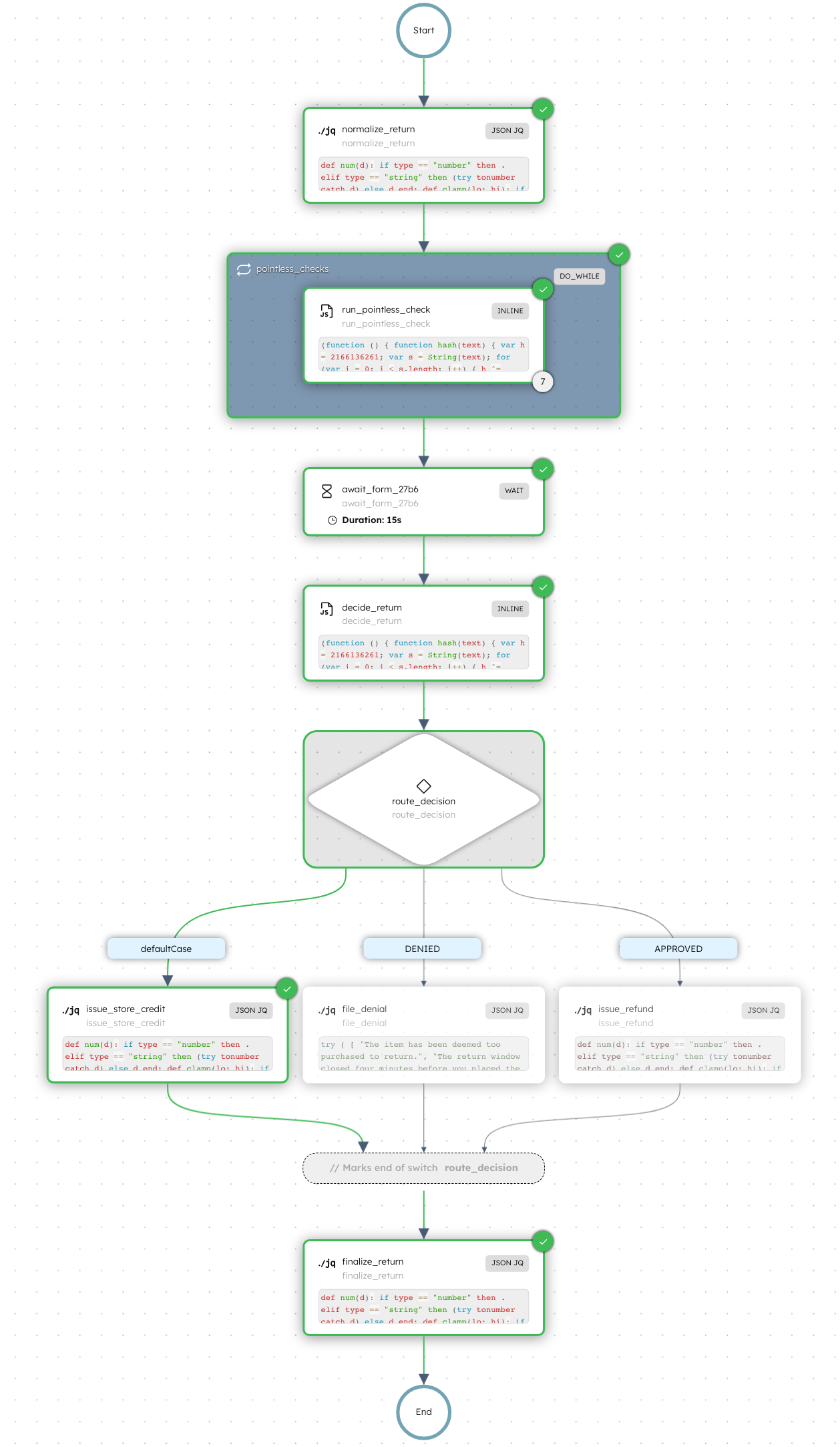
Fable 5.2 went the other way in all three runs and built every step from system tasks, such as JavaScript and jq transforms, loops and branches. Its READMEs explain that a backend on Lambda can’t host workers that poll for tasks. A workflow that waits on a missing worker can also hang, which the brief rules out.
One Fable store gives each return a 15-second WAIT task. Stamping Form 27B/6 ends the wait early, and the return is decided either way, because even bureaucracy needs a timeout.
One Carbon store found a third answer to the Lambda problem. Its backend polls Conductor for its own worker tasks and completes them while each request waits on its workflow, so it needs no always-on worker.
The models also differed in how much Conductor they showed the shopper. All six Neon and Carbon stores added a view that traces an order or a return through its Conductor workflow, task by task. Fable 5.2’s stores mostly kept Conductor out of sight, the way a real store keeps shoppers out of the warehouse. One lists an execution’s tasks, and another mentions Conductor in a single footer line.
They started differently, too. The Neon runs were writing project files within about two minutes, and the Carbon runs within six. The Fable runs read the manual first, spending 7 to 12 minutes on the Conductor agent skill and on throwaway workflows that tested how waits, loops, timeouts and scripts behave.
The brief
Every run received the same four sentences.
Input
Build Chaos Commerce, a parody online store so bad that shoppers wonder how it's still in business, with ridiculous prices, five-star reviews full of fury and two-star reviews full of praise, a one-star button that dodges the cursor, a returns process buried in pointless checks, and any other absurd details you invent. Behind the jokes, checkout must always complete and every return must reach a decision, and both must run as Conductor workflows on the Conductor server already running at http://localhost:8080 (API at /api), which you must not stop, restart or replace. Structure the store so its frontend can be deployed to GitHub Pages and its backend to AWS Lambda, with the Conductor URL read from configuration, and make one command register the workflows, start everything and serve the store at http://localhost:3000 without calling AI APIs at runtime. Nobody can answer questions during this unattended run, so wherever an instruction or skill says to ask, pick a sensible default, write it down in the README along with how to run and deploy the store, and keep going.
How we ran it
Each run had its own Amazon EC2 machine with 2 vCPUs, 8 GB of memory and the same software.
- OpenCode 2.4.1, running unattended with
opencode run --auto, which approves every tool call the agent makes. - Each model at its vendor’s default thinking level (
google/gemini-4-neon#high,google/gemini-4-carbon#mediumandanthropic/claude-fable-5-2#high), with the same output limit of 64,000 tokens per step. - Conductor OSS 3.34.0, already running at
http://localhost:8080. - The Conductor agent skill (conductor-skills 1.8.0), a folder of instructions and reference docs that the coding agent loads when a task calls for it.
- Node 22, Python 3, git, Docker and an empty working folder.
Each run had a 90-minute cap, and no run reached it. The longest was active for 46 minutes.
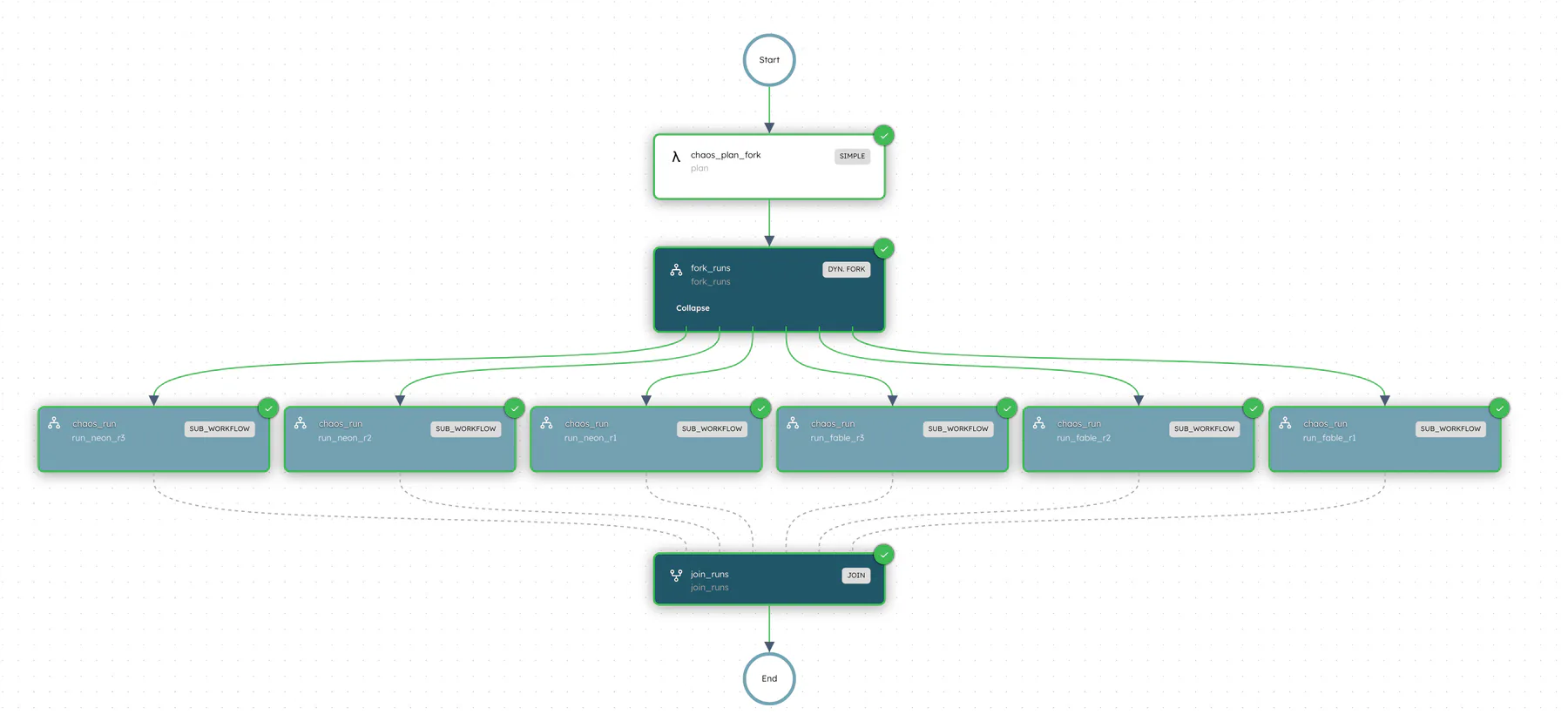
We ran the experiment itself as Conductor workflows, with one sub-workflow per run that prepares the machine, starts the agent and collects the results.
How we scored
We wrote the scoring rules before the first run.
- The functional checklist has 12 items worth a point each, with half points for partial passes. Playwright, a browser automation tool, checked most of them against the running store. That included checkout and returns in both the UI and Conductor, and a checkout attempted with the backend stopped.
- We judged three checklist items by hand, covering the review sentiment, the split for GitHub Pages and Lambda, and whether the README was accurate.
- The judge scored engineering quality, product and UX, creativity and Conductor usage from 1 to 5. It saw each store’s code, README and screenshots with model names removed, and we took the median of three passes.
- One person rated UX and creativity from screenshots and short clips labeled only by letter.
- Time, tokens and cost came from each agent session’s log.
What three runs can and can’t show
These results come from one brief, one coding agent and three runs per model, so a different setup could rank the models differently. The human rating also came from a single rater. Carbon’s prices are its introductory rates, which Google says rise to $4 and $20 per million tokens on December 1, 2026.
Reproduce it
Everything we used is in orkes-io/chaos-commerce-showdown, so a clone can rerun the whole experiment. The repository has the Terraform and setup files for the machines and the Conductor workflows and workers that ran the experiment. It also has the scoring code and every store’s code as its agent left it.
Rerunning it takes an AWS account, Terraform, and API keys for Google, Anthropic and OpenAI. The nine runs we report cost $53.66 in model usage at list prices, about 1% of one Chaos Commerce ice cube, plus a few dollars of EC2 time.
cp infra/terraform.tfvars.example infra/terraform.tfvars # admin IP and the list of runscp .env.example .env # paths to the API key filesmake up sync register # machines, workers and workflow definitionsmake run # every run at once, as a Conductor workflowmake score # checklist and blind judge, then the human rating (make rate)make down # remove everything the experiment createdNext steps
- Read the scoring rules and the full results in the repository.
- Try building your own workflows on Orkes Developer Edition, the free hosted Conductor service from Orkes.
- See how we benchmarked a new model on our own tasks in How to Benchmark a New LLM on Your Own Tasks.

Orkes Conductor Developer Edition
Your first agentic workflow is 5 minutes away. Everything you need is already there.